
Kinship, Caste and Class
Early Societies in Ancient India
2.2 The Ideal of Patriliny
Can we identify points when kinship relations changed? At one level, the Mahabharata is a story about this. It describes a feud over land and power between two groups of cousins, the Kauravas and the Pandavas, who belonged to a single ruling family, that of the Kurus, a lineage dominating one of the janapadas.
Patriliny: Tracing descent from father to son, grandson and so on.
Matriliny: The term used when descent is traced through the mother.
📍 Map: Mahajanapadas (c. 500 BCE)
Click on the map to zoom in and explore the ancient kingdoms where these events took place
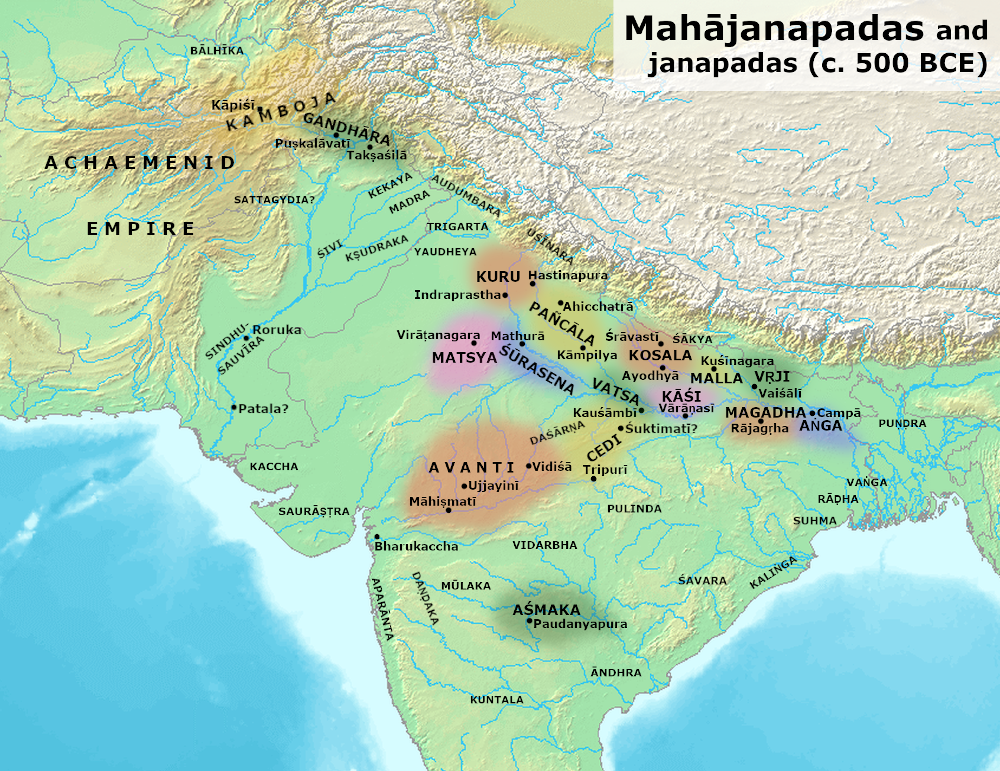
Historical Context: The Mahajanapadas period (c. 600-300 BCE) saw the rise of 16 major kingdoms and republics. The Kuru kingdom’s influence on patrilineal succession practices became a model for other kingdoms across the subcontinent.
🤔 Critical Thinking Questions:
Understanding Patrilineal Succession
Under patriliny, sons could claim the resources (including the throne in the case of kings) of their fathers when the latter died. Most ruling dynasties (c. sixth century BCE onwards) claimed to follow this system, although there were variations in practice.
👨👦 Standard Practice
Sons inherited their father’s resources and throne when he died – this became the ideal system for royal succession.
👥 Brother Succession
Sometimes there were no sons, so brothers succeeded one another in the royal line.
🤝 Kinsmen Claims
In some situations, other kinsmen claimed the throne when direct succession wasn’t possible.
👸 Exceptional Women
In very exceptional circumstances, women such as Prabhavati Gupta exercised power and ruled.
| Succession Type | Description | Frequency | Examples |
|---|---|---|---|
| Father to Son | Direct patrilineal succession | Most common | Standard royal practice |
| Brother to Brother | When no sons available | Common alternative | Dhritarashtra after Pandu |
| Other Kinsmen | Extended family claims | Occasional | Cousin claims in Mahabharata |
| Women Rulers | Exceptional circumstances | Very rare | Prabhavati Gupta |
Beyond Royal Families
The concern with patriliny was not unique to ruling families. It is evident in mantras in ritual texts such as the Rigveda. It is possible that these attitudes were shared by wealthy men and those who claimed high status, including Brahmanas.
Royal Families
Kings and ruling dynasties used patriliny to maintain power and legitimacy
Wealthy Merchants
Rich families used patrilineal inheritance to preserve wealth and property
Brahmanas
Priestly families maintained ritual knowledge and status through father-to-son transmission
High Status Groups
Those claiming social superiority adopted patrilineal practices to maintain their position
🤔 Social Analysis Questions:
Here is an excerpt of a mantra from the Rigveda, which was probably inserted in the text c. 1000 BCE, to be chanted by the priest while conducting the marriage ritual. It is used in many Hindu weddings even today:
Context: Indra was one of the principal deities, a god of valour, warfare and rain. “Here” and “there” refer to the father’s and husband’s house respectively.
🤔 Critical Analysis Question:
This is an excerpt from the Adi Parvan (literally, the first section) of the Sanskrit Mahabharata, describing why conflicts arose amongst the Kauravas and Pandavas:
“The Kauravas were the sons of Dhritarashtra, and the Pandavas were their cousins. Since Dhritarashtra was blind, his younger brother Pandu ascended the throne of Hastinapura… However, after the premature death of Pandu, Dhritarashtra became king, as the royal princes were still very young.
As the princes grew up together, the citizens of Hastinapura began to express their preference for the Pandavas, for they were more capable and virtuous than the Kauravas. This made Duryodhana, the eldest of the Kauravas, jealous.
He approached his father and said, ‘You yourself did not receive the throne, although it fell to you, because of your defect. If the Pandava receives the patrimony from Pandu, his son will surely inherit it in turn, and so will his son, and his. We ourselves with our sons shall be excluded from the royal succession and become of slight regard in the eyes of the world, lord of the earth!'”
Important Note: Passages such as these may not have been literally true, but they give us an idea about what those who wrote the text thought. Sometimes, as in this case, they contain conflicting ideas.
🤔 Critical Analysis Question:
Key Takeaways: The Ideal of Patriliny
📚 Epic Reinforcement
The Mahabharata story reinforced the value of patrilineal succession through its narrative of conflict and resolution.
👑 Royal Practice
Most ruling dynasties from the 6th century BCE onwards claimed to follow patrilineal succession, with some variations.
🏛️ Social Spread
Patriliny extended beyond royal families to wealthy merchants, Brahmanas, and other high-status groups.
⚖️ Conflicting Ideas
Ancient texts reveal tensions between hereditary rights and merit-based leadership, showing complex attitudes toward succession.
Patrilineal Succession as a Tool of Social Hierarchy:
Creating Exclusive Groups:
Reinforcing Male Authority:
Intergenerational Stability:
Cultural Legitimacy: When multiple high-status groups adopted the same system, it became seen as the “natural” and “proper” way to organize society, making it harder to challenge.