 BharatNotes
Part 4 of 6 of the Astronomical Geography notes. The overview page has the quick revision, exam strategy and key terms for all six parts.
Eclipses
An eclipse happens when one body in space moves into the shadow of another. For us there are two kinds: a solar eclipse, when the Moon's shadow falls on the Earth, and a lunar eclipse, when the Moon passes into the Earth's shadow. Both need the Sun, the Earth and the Moon to line up, and both follow from the Moon's monthly orbit, which also gives us its phases. This section builds from phases to shadows, then to the types of eclipse, why they do not happen every month, and the eclipses of 2025 and 2026.
Phases of the Moon
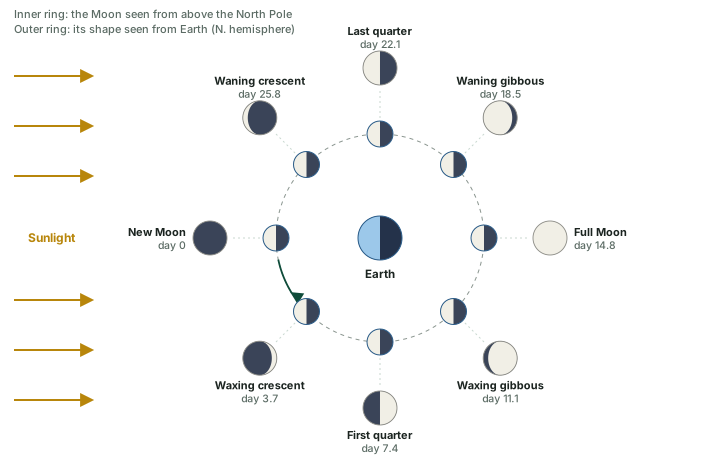
The Moon makes no light of its own: it shines by reflected sunlight. At every moment the Sun lights exactly half of the Moon, the half that faces the Sun. What changes through the month is how much of that lit half is turned towards the Earth. As the Moon goes round the Earth we see first a thin sliver of the lit half, then more, then all of it, then less again. These changing shapes are the phases of the Moon (diagram below).
The cycle runs from New Moon, when the Moon lies between the Earth and the Sun and its lit half faces away from us, through first quarter (half the disc lit), to Full Moon, when the Earth lies between the Sun and the Moon and the whole lit half faces us, then back through last quarter to New Moon. Seen from India, as from the rest of the northern hemisphere, a waxing Moon is lit on its right-hand side and a waning Moon on its left.
One full cycle of phases, from one New Moon to the next, takes 29.53 days on average: the synodic month. The Moon goes once round the Earth relative to the distant stars in a shorter time, 27.32 days, the sidereal month (both from the NASA Moon Fact Sheet). The difference of about 2.2 days arises because the Earth is moving along its own orbit at the same time. In one synodic month the Earth travels about 29° round the Sun (360° × 29.53 ÷ 365.24), so the Moon has to complete a little more than one full turn before it lines up with the Sun again.
Phases and eclipses
- New Moon: Sun, Moon and Earth in that order. Only at New Moon can there be a solar eclipse.
- Full Moon: Sun, Earth and Moon in that order. Only at Full Moon can there be a lunar eclipse.
- Both line-ups also give the strongest tides, the spring tides (see the section on Tides).
Don't confuse: Synodic vs sidereal month
Synodic month (29.53 days) is New Moon to New Moon, the month of phases and of the lunar calendar. Sidereal month (27.32 days) is one orbit measured against the stars. Phases, eclipses and tides follow the synodic month.
Shadows: umbra and penumbra
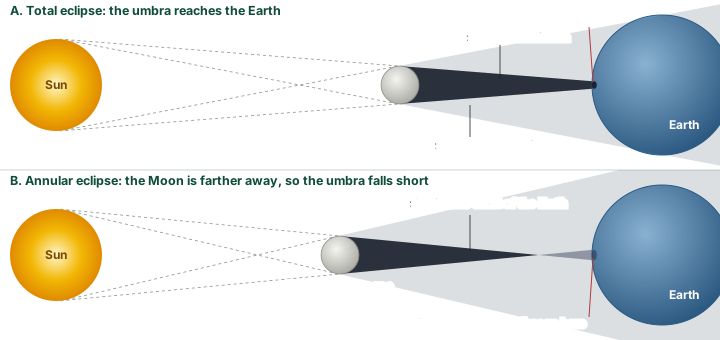
A small lamp casts a sharp shadow, but a large light source such as the Sun casts a shadow with two parts. In the dark inner part, the umbra, the whole Sun is hidden. Around it lies the penumbra, where only part of the Sun is hidden, so the light is dimmed but not cut off. NASA describes the umbra as the region "where the Sun is completely blocked" and the penumbra as the region "where the Sun is partially obscured" (NASA Science, Moon: Eclipses).
The edges of the two parts can be found with straight lines touching both the Sun and the Moon (diagram below). Lines that touch the same side of both bodies close in to a point behind the Moon: they bound the umbra, which is therefore a narrowing cone. Lines that cross between the two bodies spread out behind the Moon: they bound the penumbra, which widens with distance. Whether the tip of the umbra reaches the Earth decides whether an eclipse can be total.
Solar eclipses
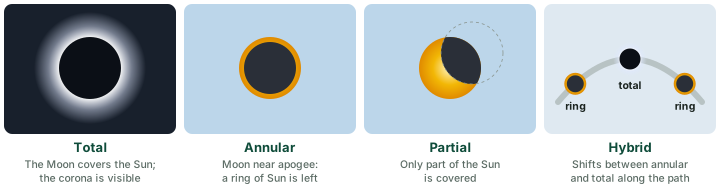
A solar eclipse happens when the Moon passes between the Sun and the Earth and its shadow falls on the Earth. It can happen only at New Moon. There are four types (diagram below; NASA Science, Types of Eclipses):
- Total: the Moon covers the whole bright face of the Sun. Only people inside the small spot of the umbra see it, and for a few minutes they can see the Sun's corona, its faint outer atmosphere.
- Annular: the Moon is at or near its farthest point from the Earth (apogee), so it looks smaller than the Sun (the Sun itself looks slightly larger in early January, when the Earth is nearest to it) and leaves a bright ring (Latin annulus, a ring) around its dark disc.
- Partial: only part of the Sun is covered. It is what people in the penumbra, outside the path of the umbra, see during any solar eclipse, and some eclipses are only partial everywhere.
- Hybrid: because the Earth's surface is curved, the eclipse shifts between annular and total as the Moon's shadow moves across the globe.
Why some eclipses are total and others annular
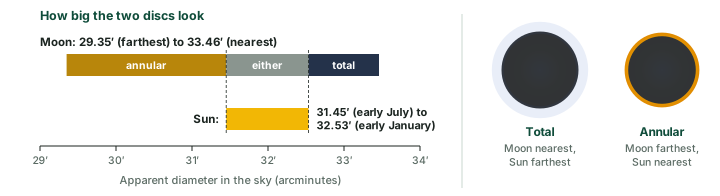
Total eclipses are possible because of a coincidence of sizes. The Sun is about 400 times wider than the Moon (695,700 km against 1,737.4 km in radius), and it is also about 389 times farther away (149.6 million km against 384,400 km). The two effects nearly cancel, so the two discs look almost the same size in our sky. Neither distance is fixed, however. The Moon's distance ranges from roughly 357,000 km to 407,000 km (NASA Moon Fact Sheet), and the Earth is nearest the Sun in early January and farthest in early July. The diagram below shows the result: when the Moon is near and covers even the largest Sun, the eclipse is total; when it is far and smaller than even the smallest Sun, it is annular.
Worked example: Annular or total?
An eclipse occurs with the Moon 407,000 km from the Earth. Can it be total?
- Moon's apparent diameter = 2 × arctan(1,737.4 ÷ 407,000) = 29.35′ (arcminutes).
- The Sun's apparent diameter is never less than 1,887″ = 31.45′ (NASA Sun Fact Sheet).
- 29.35′ is smaller than 31.45′, so the Moon cannot cover the Sun.
- Even an observer directly under the Moon, about 6,371 km (one Earth radius) closer, sees 2 × arctan(1,737.4 ÷ 400,629) = 29.82′, still too small.
Answer: No. With the Moon this far away the eclipse is annular wherever the Moon is centred on the Sun.
Lunar eclipses
A lunar eclipse happens when the Earth passes between the Sun and the Moon, so that the Moon moves into the Earth's shadow. It can happen only at Full Moon. The Earth's shadow has the same two parts as the Moon's, but it is far larger: at the Moon's distance the umbra is roughly 2.6 times as wide as the Moon (diagram below). There are three types, named by the part of the shadow the Moon enters (NASA GSFC, Lunar Eclipses 2021-2030 (Espenak)):
- Total: the whole Moon passes into the umbra.
- Partial: only part of the Moon enters the umbra; the rest stays in the penumbra.
- Penumbral: the Moon passes only through the penumbra. NASA notes that the Moon then "dims so slightly that it can be difficult to notice" (NASA Science, Moon: Eclipses).
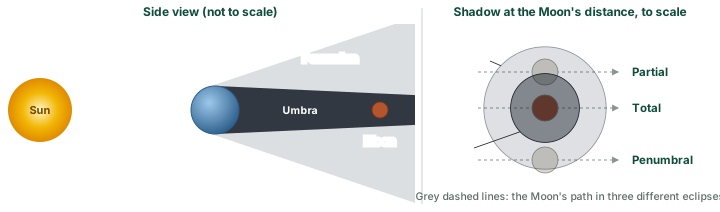
Unlike a total solar eclipse, which is seen only inside the small spot of the umbra, a lunar eclipse can be seen by everyone on the night side of the Earth while it lasts. In NASA's words, "Each lunar eclipse is visible from half of Earth" (NASA Science, Moon: Eclipses). A lunar eclipse also lasts much longer: the total eclipse of 7-8 September 2025 stayed total for 82 minutes (Section 7.6).
Why the totally eclipsed Moon turns red
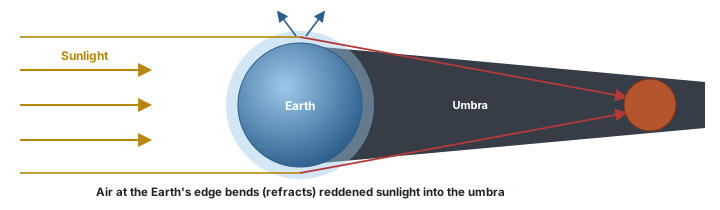
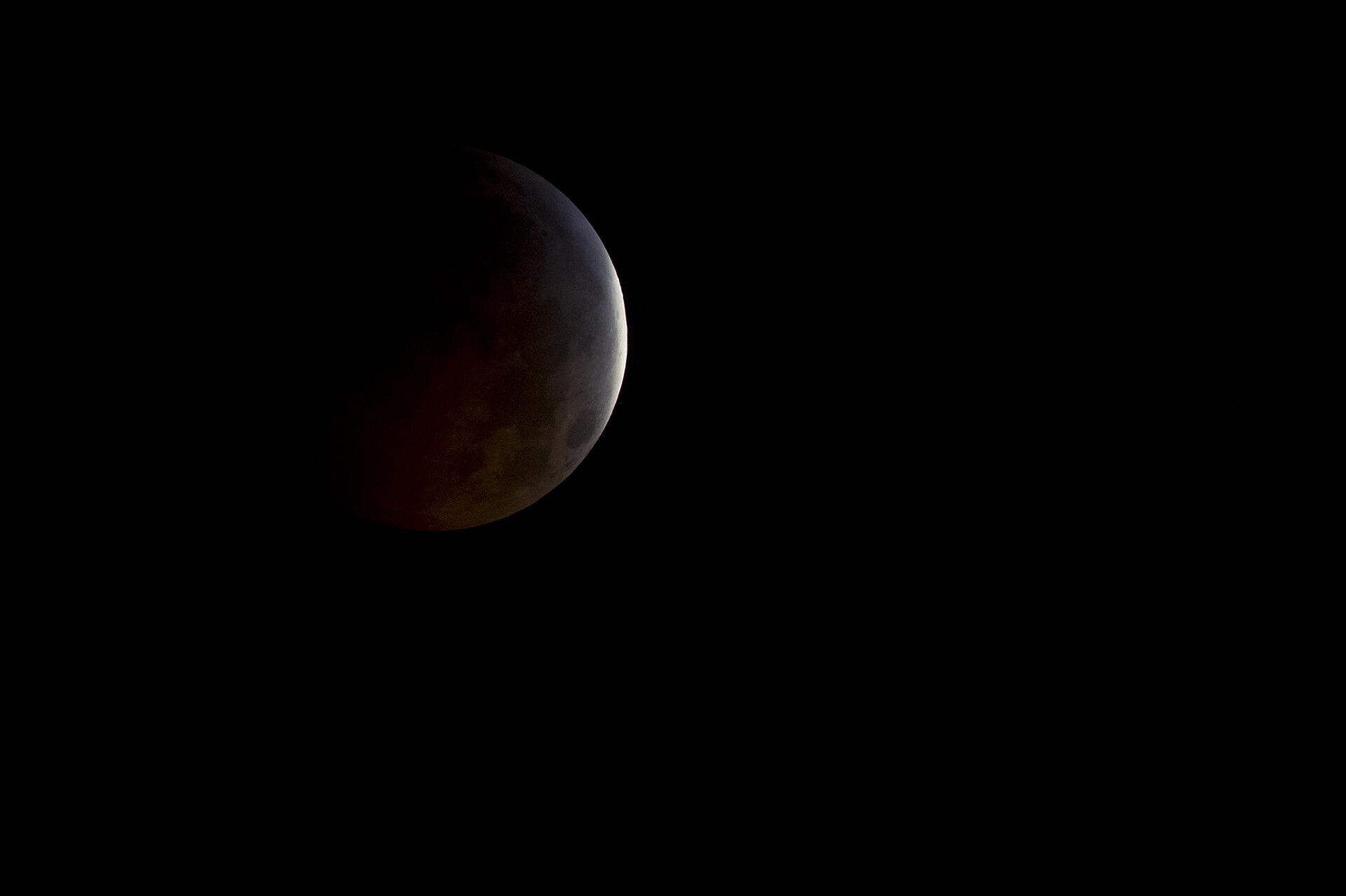
Even inside the umbra the Moon does not vanish. Some sunlight passes through the thin ring of air around the edge of the Earth and is bent (refracted) into the shadow. On its long path through the air, blue and violet light is scattered out of the beam, because, as NASA explains, the blues and violets scatter more easily than colours of longer wavelength. What reaches the Moon is mostly red and orange light, the same light that colours sunrises and sunsets: NASA describes it "as if all the world's sunrises and sunsets are projected onto the Moon" (NASA Science, Moon: Eclipses). The amount of dust in the air changes the result, so, in the words of a NASA picture page, "each eclipse can have a different appearance" (NASA Astronomy Picture of the Day, 26 Jul 2000).
Don't confuse: Scattering vs refraction
Two effects work together. Scattering removes blue light from sunlight crossing the Earth's air; refraction by that air bends the remaining reddened light into the shadow and onto the Moon.
Penumbral vs partial: in a partial eclipse part of the Moon is in the dark umbra and looks "bitten"; in a penumbral eclipse the Moon is only slightly dimmed.
Solar and lunar eclipses compared
| Solar eclipse | Lunar eclipse | |
|---|---|---|
| Line-up | Sun, Moon, Earth (Moon in the middle) | Sun, Earth, Moon (Earth in the middle) |
| Phase of the Moon | New Moon | Full Moon |
| Shadow | The Moon's shadow falls on the Earth | The Moon moves into the Earth's shadow |
| Who can see it | Total or annular only inside the small area of the umbra (or beyond its tip) as it moves across the Earth; partial over a wider area | Everyone on the night half of the Earth |
| Types | Total, annular, partial, hybrid | Total, partial, penumbral |
| Number in a calendar year | 2 to 5 | 2 to 5 |
NASA Science, Types of Eclipses; NASA Science, Moon: Eclipses; numbers per year from the NASA Five Millennium Catalog of Solar Eclipses and the NASA Five Millennium Catalog of Lunar Eclipses.
Why there is not an eclipse every month
If the Moon went round the Earth in the same plane as the Earth goes round the Sun, every New Moon would bring a solar eclipse and every Full Moon a lunar one. In fact the Moon's orbit is, in NASA's words, "tilted about 5 degrees" to the plane of the Earth's orbit, and this tilt "prevents us from having monthly solar and lunar eclipses" (NASA Science, Moon: Eclipses). In most months the New Moon passes a little above or below the Sun as seen from the Earth, and its shadow misses us; the Full Moon likewise passes above or below the Earth's shadow (diagram below).
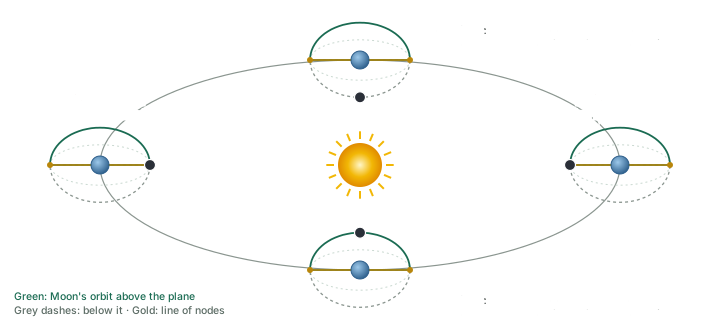
The Moon's orbit crosses the plane of the Earth's orbit at two points called the nodes; the line joining them is the line of nodes. An eclipse can happen only when a New Moon or a Full Moon falls close to a node, and that is possible only during the weeks when the line of nodes points towards the Sun. NASA: "The time when they are aligned is known as eclipse season, which happens twice a year" (NASA Science, Types of Eclipses).
At least two solar eclipses every year
F. Espenak of NASA explains that a solar eclipse is seen somewhere on the Earth "If New Moon takes place within about 17° of a node", and that "it takes 34.5 days for the Sun to cross the 34° wide eclipse zone centered on each node". Since 34.5 days is longer than the 29.53 days between New Moons, at least one New Moon must fall inside every eclipse season. So every eclipse season has at least one solar eclipse, and every year has at least two. If a New Moon falls in the first 5 days or so of a season, the next one falls inside it too, and the season has two (F. Espenak, NASA GSFC, Periodicity of Solar Eclipses).
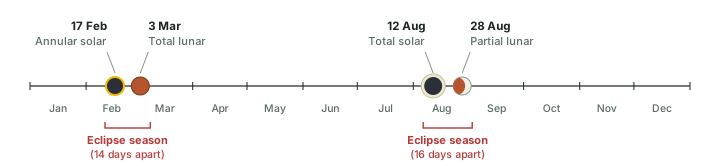
The eclipse seasons do not stay on the same dates. The nodes slowly turn backwards, "westward by 19.3° per year", so the Sun meets each node again a little before a full year has passed. According to Espenak, "The mid-point of each eclipse season is separated by 173.3 days" (F. Espenak, NASA GSFC, Periodicity of Solar Eclipses). Two seasons therefore take 2 × 173.3 = 346.6 days, and each year the seasons arrive about 18.6 days earlier than the year before (365.24 − 346.6). The eclipses come in short clusters: within one season, a solar and a lunar eclipse are often only about two weeks apart, half of a 29.53-day month. The diagram below shows the four eclipses of 2026, two in each season.
| Number | What it is |
|---|---|
| 2 to 5 | solar eclipses in a calendar year |
| 2 to 5 | lunar eclipses in a calendar year (penumbral included) |
| 4 to 7 | eclipses of both kinds in a year |
| 7 min 29 s | longest totality in NASA's Five Millennium Catalog: 16 July 2186 |
| 173.3 d | between the middles of two eclipse seasons |
| 6,585.3 d | one Saros: 18 years 11 days 8 hours |
Sources: NASA Five Millennium Catalog of Solar Eclipses; NASA Five Millennium Catalog of Lunar Eclipses; NASA Science, Moon: Eclipses ("Anywhere from four to seven times a year"); F. Espenak, NASA GSFC, Periodicity of Solar Eclipses; F. Espenak, NASA GSFC, Eclipses and the Saros.
The Saros cycle
Eclipses repeat in a cycle called the Saros. Espenak gives it as "approximately 6,585.3 days (18 years 11 days 8 hours)", equal to 223 synodic months. Eclipses one Saros apart "occur at the same node with the Moon at nearly the same distance from Earth and at the same time of year", so the eclipses of one Saros series resemble each other (F. Espenak, NASA GSFC, Eclipses and the Saros).
Worked example: Where does the next eclipse of a Saros fall?
A total solar eclipse is seen over some region. Where will the eclipse one Saros later be seen?
- One Saros = 223 synodic months = 223 × 29.53 ≈ 6,585.2 days (NASA gives 6,585.3 days, or 18 years 11 days 8 hours, using the unrounded month).
- The whole days bring the Sun, Moon and node back to almost the same line-up. The extra 8 hours do not.
- In 8 hours the Earth turns 8 × 15° = 120° (it turns 15° an hour), so the same line-up happens over a place about 120° of longitude farther west.
- After three Saros cycles (3 × 8 hours = 24 hours) the extra turning adds up to a whole day, so the eclipse returns to roughly the same longitude: 3 Saros = 54 years 34 days.
Answer: About 120° of longitude to the west. Espenak notes that the region returns "every 3 saroses (54 years and 34 days)" (F. Espenak, NASA GSFC, Eclipses and the Saros).
The eclipses of 2025 and 2026
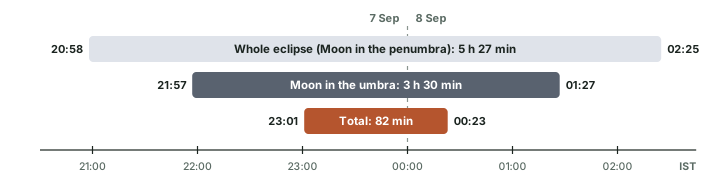
The total lunar eclipse of 7-8 September 2025 could be seen from the whole country, with totality from 23:01 to 00:23 IST. The Astronomical Society of India (ASI) announced beforehand that "The entire eclipse will be visible from all parts of India." ASI also made a point worth remembering: "The timings of the various stages of the lunar eclipse are the same for all observers on the Earth" (Astronomical Society of India, Total Lunar Eclipse 2025). The Moon enters the Earth's shadow at one instant for everyone who can see it; only the clock reading changes from one time zone to another (see the section on Longitude and Time).
The year 2026 has four eclipses, two solar and two lunar, in two eclipse seasons about six months apart (table below, and the one-year eclipse line above). Only one of them, the total lunar eclipse of 3 March, could be seen from India at all, and only in part. ARIES Nainital's advance note said: "In India, only the North East states and Andaman & Nicobar Islands will get to observe the last few minutes of the totality after the Moon rises. For most of India, including Uttarakhand, the total phase will get over before the moonrise." Elsewhere in India the eclipse would be "visible only as a Partial Lunar Eclipse", and the Moon would leave the umbra at 18:47 IST (ARIES Nainital, total lunar eclipse of 3 March 2026).
The eclipses of 2026
| Date (2026) | Type | Where it is seen (NASA) | Duration | Seen from India? |
|---|---|---|---|---|
| 17 February | Annular solar | Annular path over Antarctica; partial from southern Argentina and Chile and southern Africa | Annular phase up to 2 min 20 s | No: India is not in the region |
| 3 March | Total lunar | Eastern Asia, Australia, the Pacific, the Americas | Totality 58 min; umbral phases 3 h 27 min | Partly: the end of totality from the North East and the Andaman & Nicobar Islands; elsewhere partial, at moonrise |
| 12 August | Total solar | Total over the Arctic, Greenland, Iceland and Spain; partial from northern North America, western Africa and Europe | Totality up to 2 min 18 s | No: greatest eclipse at about 23:17 IST, at night in India |
| 28 August | Partial lunar | The eastern Pacific, the Americas, Europe, Africa | Umbral phases 3 h 18 min | No: greatest eclipse at about 09:44 IST, in the Indian morning, when the Full Moon (opposite the Sun) is below the horizon |
NASA GSFC, Solar Eclipses 2021-2030 (Espenak); NASA GSFC, Lunar Eclipses 2021-2030 (Espenak); ARIES Nainital, total lunar eclipse of 3 March 2026. IST of greatest eclipse = NASA's time (Terrestrial Dynamical Time, TD) + 5 h 30 min, rounded; TD differs slightly from clock time, so these are approximate. Check: the same rule gives 23:43 for 7 September 2025, close to the middle of ASI's totality (23:01 to 00:23, midpoint 23:42).
Watching a solar eclipse safely
NASA's rule: "Except during the brief total phase of a total solar eclipse, when the Moon completely blocks the Sun’s bright face, it is not safe to look directly at the Sun without specialized eye protection for solar viewing."
- "Eclipse glasses are NOT regular sunglasses"; safe viewers "ought to comply with the ISO 12312-2 international standard".
- A camera, binoculars or a telescope needs a special solar filter "attached to the front"; eclipse glasses are not a substitute for one.
- An indirect method is safe: a pinhole projector throws an image of the Sun onto a surface, viewed with the Sun at your back.
Sources
Each table and data figure names its source beneath it. The main documents are collected here, with a date where the source carries one. Figures not listed under image credits were drawn for this page from the data and formulas stated in their source lines.
Main sources
| Topic | Source |
|---|---|
| Planets, the Sun and the Earth | NASA Planetary Fact Sheet (18 Mar 2025); NASA Earth Fact Sheet; NASA, Earth facts; NASA, Sun facts |
| Eclipses | NASA, eclipses; NASA Five Millennium Catalog of Solar Eclipses; NASA Five Millennium Catalog of Lunar Eclipses; ASI, 2025; ARIES, 2026 |
Image credits
| Image | Credit and licence |
|---|---|
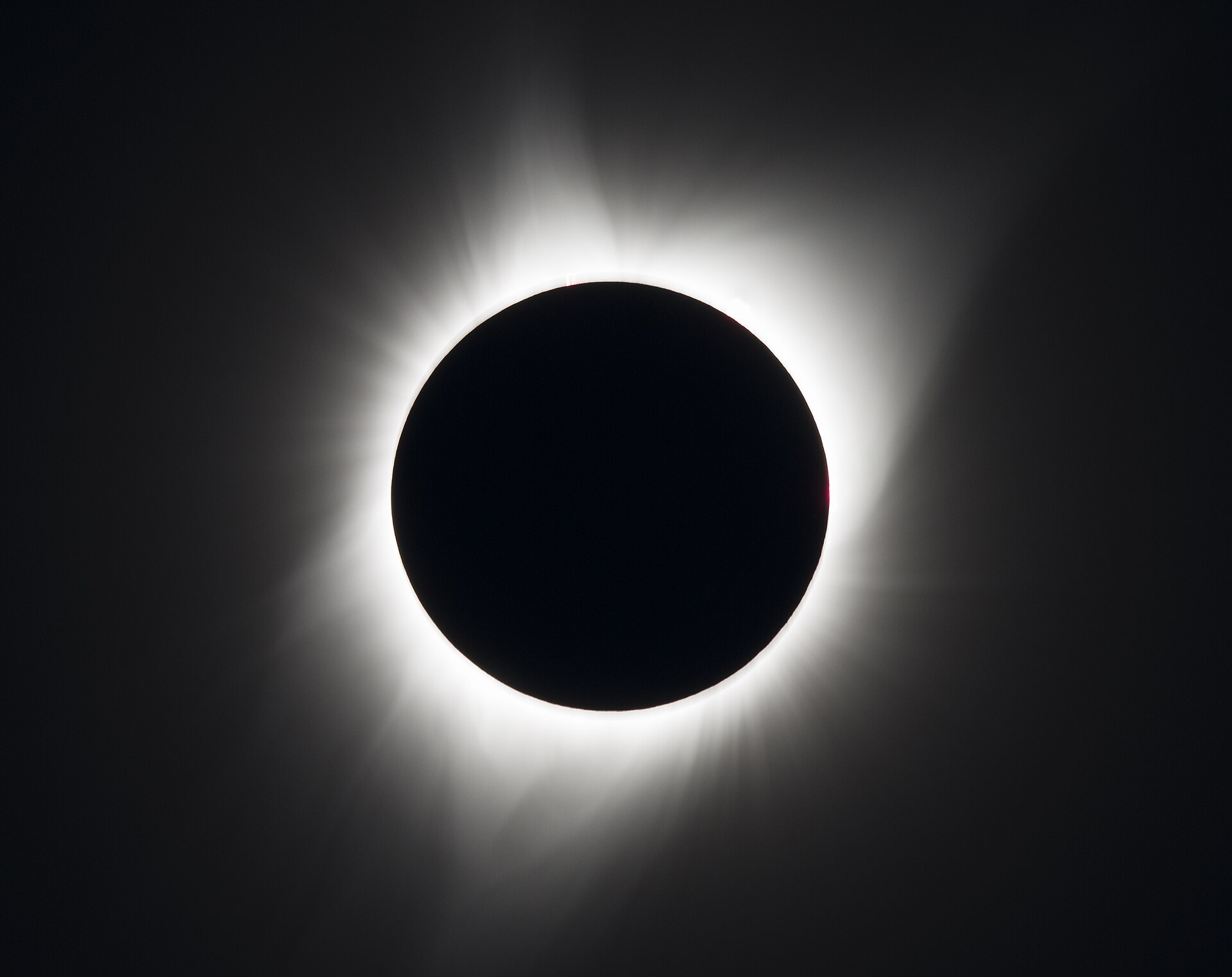
| Total solar eclipse, 21 Aug 2017, Madras, Oregon (see the section on Eclipses) | Aubrey Gemignani, NASA. CC BY 2.0. File page |
| Total lunar eclipse, 21 Dec 2010, Arlington, Virginia (see the section on Eclipses) | Bill Ingalls, NASA. Public domain. File page |
| All other figures | Drawn for this page from the data and formulas given in their source lines. |