 BharatNotes
Part 8 of 9 of the Soils and Biogeography notes. The overview page has the quick revision and exam strategy for all nine parts.
Biodiversity and Hotspots
Part 4.6 sorted the living world by climate and part 4.7 by history. This part counts it: what biodiversity means, how many species there may be, where the richest and most threatened places lie, and how the world has agreed to protect them. India holds parts of four of the world's 36 biodiversity hotspots, and this part checks each on the map.
Cross-paper relevance
- GS1 (Geography, primary): the three levels of biodiversity, how many species there are and where, megadiverse countries, the 36 hotspots and India's four
- GS3 (Environment): biodiversity conservation: the drivers of loss, the IUCN Red List, in-situ and ex-situ conservation, the CBD and the Kunming-Montreal Global Biodiversity Framework
Three levels of biodiversity
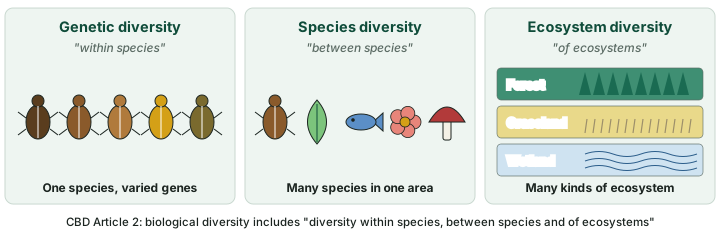
NCERT discusses biodiversity at three levels: genetic, species and ecosystem diversity. Genetic diversity is, in NCERT's words, "the variation of genes within species": people, for example, belong to one species yet differ in height, colour and appearance. Species diversity "refers to the variety of species"; NCERT adds that it can be measured through "richness, abundance and types". Ecosystem diversity is the variety of ecosystem types and habitats in an area, such as forest, grassland and wetland. The Convention on Biological Diversity (CBD) builds the same three levels into its legal definition: biological diversity "includes diversity within species, between species and of ecosystems" (Article 2). The diagram below sets the three side by side.
Endemic, native and exotic
Three words describe how a species belongs to a place, and they are easily confused. An endemic species is one "found nowhere else on Earth" (Conservation International's wording for the plants that define a hotspot). An exotic species is the opposite case; NCERT defines it exactly: "Species which are not the natural inhabitants of the local habitat but are introduced into the system, are called exotic species". A native species is simply a natural inhabitant of the place. Every endemic species is native where it lives, but a native species need not be endemic: it may live naturally in other places too. Endemism is therefore a statement about the whole world; nativeness is a statement about one place.
Remember
Endemic = only here. Native = naturally here (and perhaps elsewhere too). Exotic = brought here from elsewhere.
How many species are there?
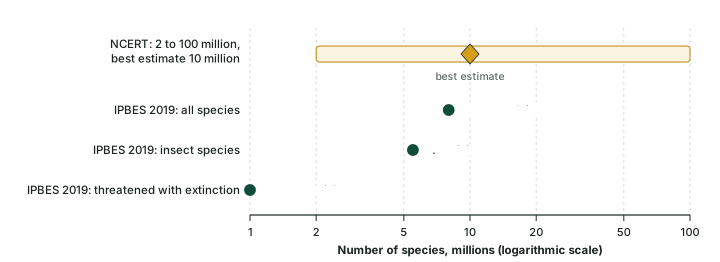
Nobody knows the number of species on Earth, and the two sources most used in India give different kinds of answer. NCERT gives a range: "The number of species globally vary from 2 million to 100 million, with 10 million being the best estimate." The Intergovernmental Science-Policy Platform on Biodiversity and Ecosystem Services (IPBES), in the media release for its 2019 Global Assessment, puts the total at about 8 million animal and plant species, including 5.5 million insect species, and warns that "around 1 million animal and plant species are now threatened with extinction". The chart below puts these on one logarithmic axis, where each step of the scale is a multiple rather than an addition: the IPBES total falls inside NCERT's range, a little below its best estimate.
Species are not spread evenly. NCERT puts the pattern plainly: "It is consistently richer in the tropics. As one approaches the polar regions, one finds larger and larger populations of fewer and fewer species." NCERT also notes that tropical rain forests contain about 50 per cent of the species on Earth, and that tropical regions, about one-fourth of the world's area, hold about three-fourths of its people: the richest regions are also under the most pressure. Loss is not new either; in NCERT's words, "99 per cent of the species that have ever lived on the earth are today extinct". What is new is the pace, taken up below under threats and the IUCN categories.
Megadiverse countries and biodiversity hotspots
Two ideas pick out the world's most important places for biodiversity, and they answer different questions. A megadiverse country is a whole nation that holds a very large number of species. NCERT lists twelve: "They are called mega diversity centres. There are 12 such countries", namely Mexico, Colombia, Ecuador, Peru, Brazil, the Democratic Republic of Congo, Madagascar, China, India, Malaysia, Indonesia and Australia (NCERT's list; NCERT spells the second name "Columbia"). A biodiversity hotspot is a region, drawn on biological rather than political lines, that is both unusually rich in endemic plants and badly damaged. Conservation International (CI) sets two tests: a hotspot "must hold at least 1,500 endemic plant species", and "it must have already lost at least 70 percent of its original natural vegetation". Mittermeier et al. (2011) give the same first test as at least 1,500 endemic vascular plants, more than 0.5% of the world's total.
- 36 biodiversity hotspots (CI, 2016 onward)
- 1,500 endemic plant species: the minimum for a hotspot
- 70% of original vegetation lost: the minimum for a hotspot
Why plants? NCERT gives the reason: "Plants are important because these determine the primary productivity of an ecosystem." Because the test is endemism plus loss, not richness alone, a very rich region can fail it. CI notes that the Amazon "still retains more than 30 percent of its original vegetation", so it is not a hotspot, while its neighbouring biome, Brazil's Cerrado savanna, is one.
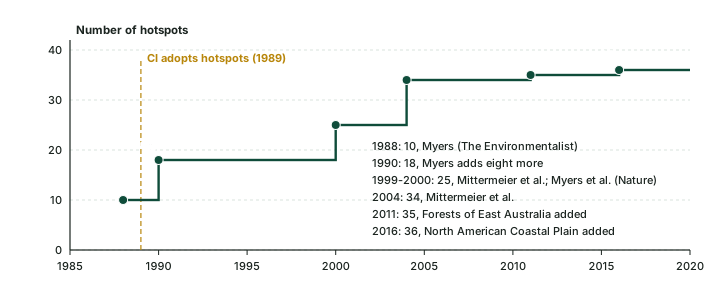
The idea grew over three decades (see the chart below). On CI's own page it was "first proposed by ecologist Norman Myers and later formalized by Conservation International". Myers named 10 tropical forest hotspots in 1988 and "added eight additional hotspots" in 1990, making 18. CI adopted hotspots "as an institutional blueprint in 1989" and, with Myers, set the two tests. A fuller analysis raised the count to 25 (Mittermeier et al. 1999; Myers et al. 2000, in Nature), which found 44% of vascular plants and 35% of the species in four vertebrate groups confined to 25 hotspots covering 1.4% of the land. The count became 34 in 2004, 35 in 2011 with the Forests of East Australia, and 36 in February 2016 with the North American Coastal Plain. NCERT credits the International Union for Conservation of Nature (IUCN), saying it "has identified certain areas as biodiversity hotspots"; the concept is Myers's and the current list is CI's.
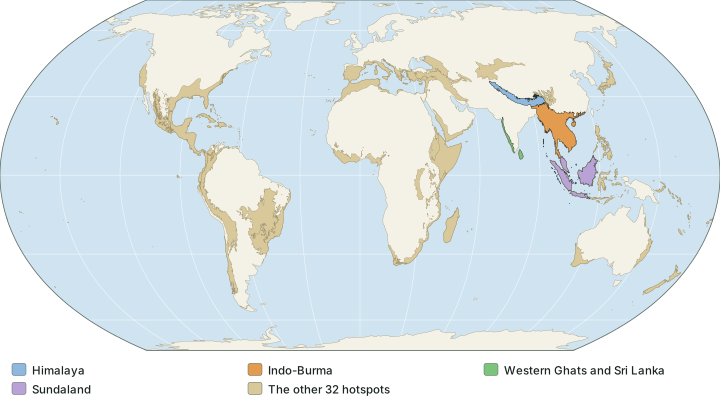
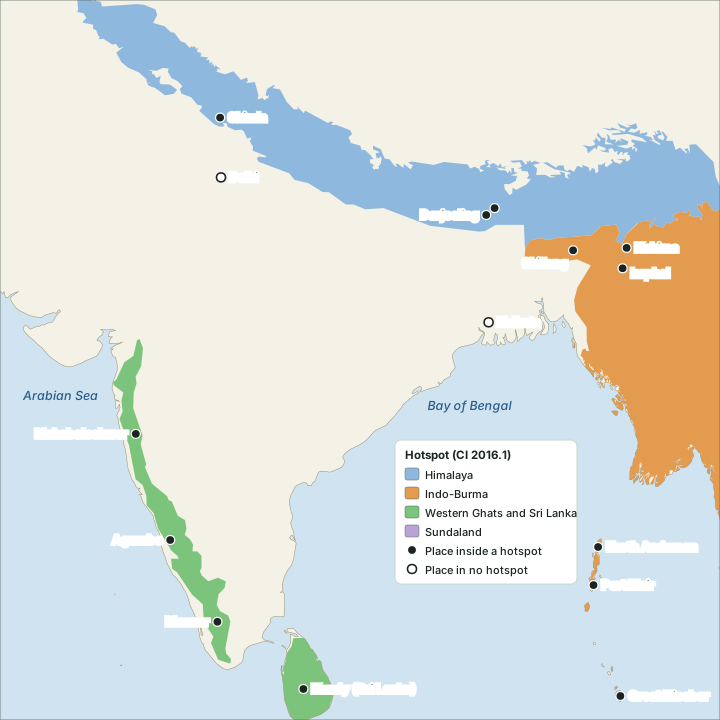
The map below shows the 36 hotspots, with India's four in colour.
Don't confuse
Megadiverse country or hotspot? A megadiverse country is a nation with very many species (NCERT lists 12). A hotspot is a region with at least 1,500 endemic plant species that has lost at least 70% of its original vegetation; it ignores borders (Western Ghats and Sri Lanka spans two countries). India is both: one of NCERT's 12 countries, and home to parts of four hotspots. NCERT's "hotspots of diversity": NCERT also uses the word loosely for areas rich in species diversity. The CI hotspot is the stricter, two-test meaning used in this part.
What the hotspots hold
The case for hotspots is that a small area holds a large share of the world's unique life. Mittermeier et al. (2011), analysing 35 hotspots, found that they once covered 23.7 million km², or 15.9% of the Earth's land surface. More than 85% of that original habitat has been lost: the natural vegetation left covers 3.4 million km², just 2.3% of the land, a little more than the land area of India. Yet more than 152,000 plant species, over half the world's total, are found in a single hotspot and nowhere else. Of all terrestrial vertebrates, 22,939 (77% of the total) occur in hotspots and 12,717 (43%) occur only there. About 2.08 billion people (31.8% of humanity) live in them, and about 12% of their original area is protected.
Two area figures circulate. CI's page today says the 36 hotspots cover "just 2.5 percent of Earth's land surface"; Mittermeier et al. gave 2.3% for the remaining natural vegetation of 35 hotspots in 2011. The two differ in date and in the number of hotspots counted, so quote each with its source.
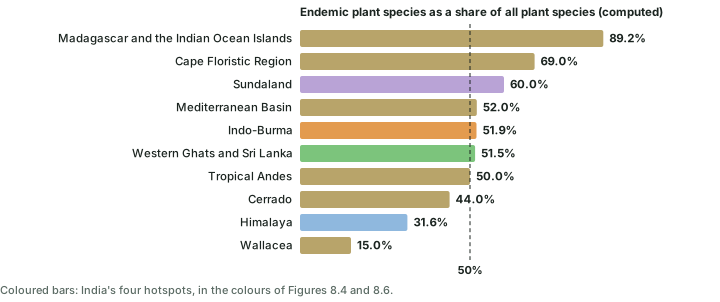
Plant species and endemism in ten hotspots
| Hotspot | Plant species | Endemic plant species | Endemic share (computed) |
|---|---|---|---|
| Tropical Andes | 30,000 | 15,000 | 50.0% |
| Mediterranean Basin | 22,500 | 11,700 | 52.0% |
| Sundaland | 25,000 | 15,000 | 60.0% |
| Indo-Burma | 13,500 | 7,000 | 51.9% |
| Madagascar and the Indian Ocean Islands | 13,000 | 11,600 | 89.2% |
| Himalaya | 10,000 | 3,160 | 31.6% |
| Wallacea | 10,000 | 1,500 | 15.0% |
| Cerrado | 10,000 | 4,400 | 44.0% |
| Cape Floristic Region | 9,000 | 6,210 | 69.0% |
| Western Ghats and Sri Lanka | 5,916 | 3,049 | 51.5% |
Data: Mittermeier et al. (2011), "Global biodiversity conservation: the critical role of hotspots", in F.E. Zachos and J.C. Habel (eds.), Biodiversity Hotspots (Springer, 2011), Table 1.2 (hotspot totals from Mittermeier et al. 2004). The shares are computed: endemic species divided by all species.
Worked example: Reading an endemic share
The Western Ghats and Sri Lanka hotspot has 5,916 plant species, of which 3,049 are endemic. What share is endemic, and how does Madagascar compare with NCERT's figure?
- Endemic share = endemic species / all species = 3,049 / 5,916 = 0.515, or 51.5%.
- Madagascar and the Indian Ocean Islands: 11,600 / 13,000 = 0.892, or 89.2% of plants.
- NCERT says that in Madagascar "about 85 per cent of the plants and animals are found nowhere else in the world". Its figure covers plants and animals together and Madagascar alone; the 89.2% covers plants only, for the whole hotspot, from 2004 data.
Answer: About half the plants of the Western Ghats and Sri Lanka are endemic. The two Madagascar figures measure different things, so both can stand, each with its basis.
India's four hotspots
India holds parts of four hotspots: the Himalaya, Indo-Burma, the Western Ghats and Sri Lanka, and Sundaland. The map after the table checks real places against the 2016 hotspot boundaries. Shimla (Himachal Pradesh), Darjeeling (West Bengal) and Gangtok (Sikkim) fall in the Himalaya. Shillong (Meghalaya), Kohima (Nagaland) and Imphal (Manipur) fall in Indo-Burma, and so do the Andaman Islands (North Andaman and Port Blair). The Nicobar Islands belong to a different hotspot: Great Nicobar falls in Sundaland, with the islands of the Sunda Shelf (part 4.7). Mahabaleshwar (Maharashtra), Agumbe (Karnataka) and Munnar (Kerala) fall in the Western Ghats and Sri Lanka, together with Kandy in Sri Lanka. Delhi and Kolkata fall in no hotspot.
The boundaries have a history. Myers's first list of 1988 already included the Western Ghats in India, south-western Sri Lanka and the Eastern Himalayas. Later revisions merged the first two into one hotspot and divided the Eastern Himalayas between Indo-Burma and the Mountains of South-Central China; when Indo-Burma was redefined, the Himalayan chain was separated as a hotspot of its own (Mittermeier et al. 2011, Table 1.1). The table below compares the four.
India's four hotspots: all species and (endemic species)
| Hotspot | Plants | Birds | Reptiles | Freshwater fishes | Amphibians | Mammals |
|---|---|---|---|---|---|---|
| Himalaya | 10,000 (3,160) | 979 (15) | 177 (49) | 269 (33) | 111 (46) | 269 (18) |
| Indo-Burma | 13,500 (7,000) | 1,277 (73) | 518 (204) | 1,262 (553) | 328 (193) | 401 (100) |
| Western Ghats and Sri Lanka | 5,916 (3,049) | 457 (35) | 265 (176) | 191 (139) | 204 (156) | 143 (27) |
| Sundaland | 25,000 (15,000) | 771 (146) | 449 (244) | 950 (350) | 258 (210) | 397 (219) |
Data: Mittermeier et al. (2011), "Global biodiversity conservation: the critical role of hotspots", in F.E. Zachos and J.C. Habel (eds.), Biodiversity Hotspots (Springer, 2011), Table 1.2 (hotspot totals from Mittermeier et al. 2004; the whole hotspot, not India's part alone).
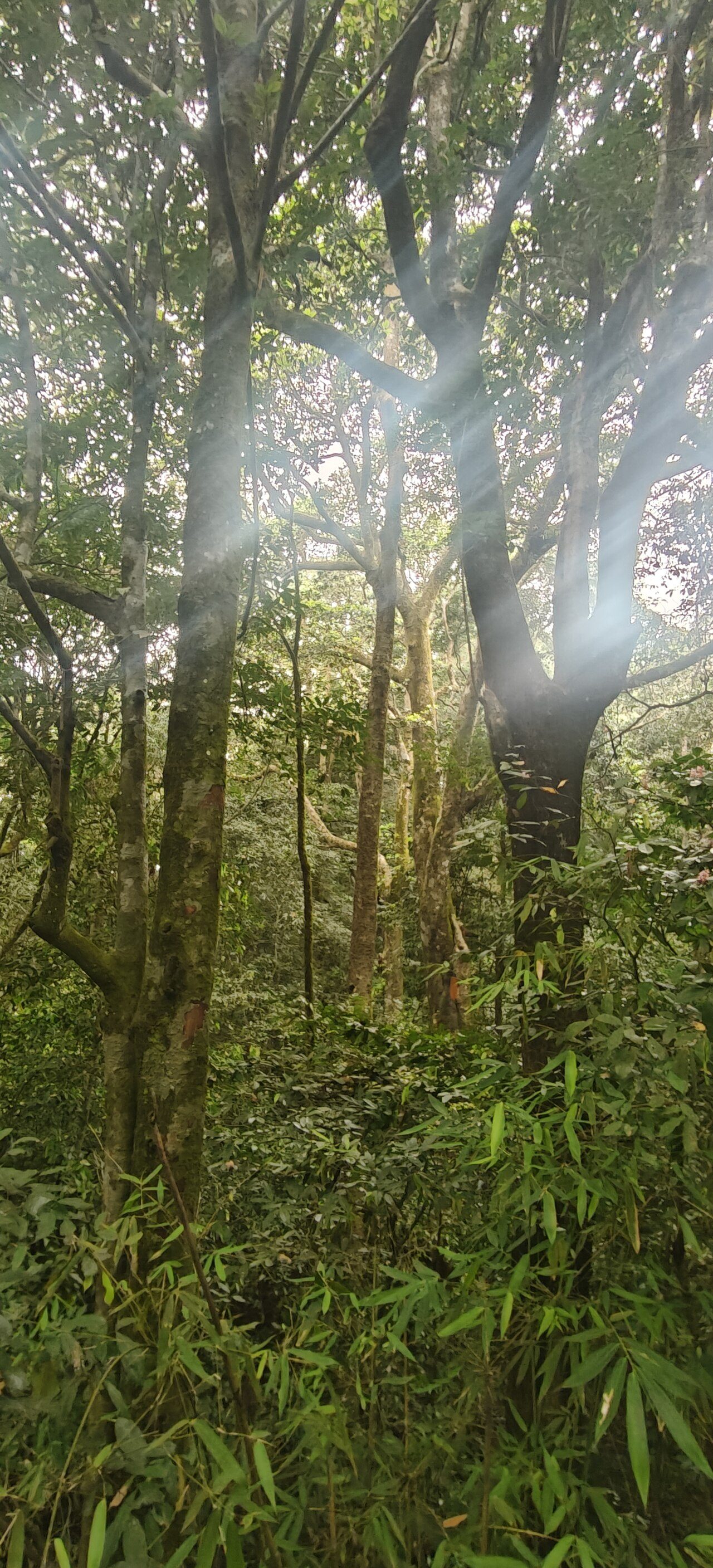
Two patterns stand out. Sundaland has the most plant species of the four and the highest endemic share; Indo-Burma has the most freshwater fishes, 553 of them endemic. In the Western Ghats and Sri Lanka, 156 of 204 amphibians are endemic, while the Himalaya has 979 bird species but only 15 endemic ones. The forests and grasslands of the Western Ghats appear in the photos below. NCERT notes that the temperate forests of the southern hills have their own name: "The temperate forests are called Sholas in the Nilgiris, Anaimalai and Palani hills."
Threats and the IUCN categories
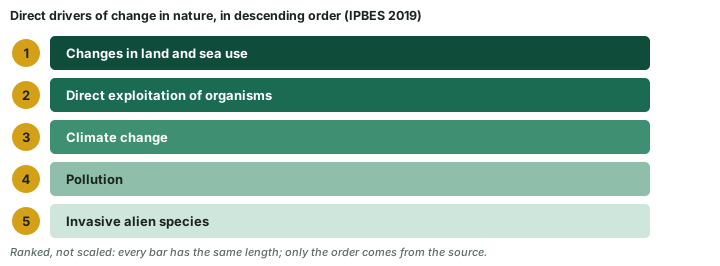
The IPBES Global Assessment ranked the five direct drivers of change in nature with the largest relative global impacts so far. In the words of its media release: "These culprits are, in descending order: (1) changes in land and sea use; (2) direct exploitation of organisms; (3) climate change; (4) pollution and (5) invasive alien species." The same release reports that three-quarters of the land-based environment and about 66% of the marine environment have been significantly altered by human actions, that more than 40% of amphibian species are threatened, and that at least 680 vertebrate species have been driven to extinction since the 16th century. NCERT adds the human side: over-exploitation of resources and deforestation in the populous tropics, and, on islands such as Hawaii, the threat from introduced species and land development.
To decide which species need help, the IUCN Red List places each assessed species in a category. NCERT still describes an older scheme of three categories. An endangered species is one in "danger of extinction"; a vulnerable species is one "likely to be in danger of extinction in near future if the factors threatening to their extinction continue"; and for a rare species, "Population of these species is very small in the world". The Red List today uses nine categories: EX (Extinct), EW, CR, EN, VU, NT, LC, DD and NE. "Rare" is not one of them. Species in the three categories Critically Endangered, Endangered and Vulnerable are together called threatened (see the diagram below).
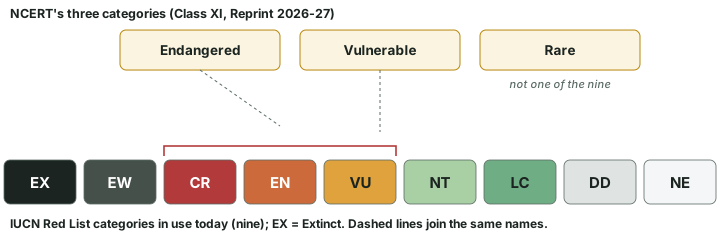
In its update of 9 July 2026, the IUCN reported 175,909 species assessed, of which 49,505 are threatened with extinction, about 28.1% (computed). The same update listed five Australian marsupials, newly recognised as species through a taxonomic review, as already Extinct.
In-situ and ex-situ conservation
The CBD defines the two basic ways of conserving biodiversity in Article 2. In-situ conservation means "the conservation of ecosystems and natural habitats and the maintenance and recovery of viable populations of species in their natural surroundings". Ex-situ conservation means "the conservation of components of biological diversity outside their natural habitats". The treaty's first in-situ duty, Article 8(a), is to "Establish a system of protected areas or areas where special measures need to be taken to conserve biological diversity". Article 9 places ex-situ work "predominantly for the purpose of complementing in-situ measures", preferably in the country of origin, through facilities for plants, animals and micro-organisms, and it links the two: parties should "Adopt measures for the recovery and rehabilitation of threatened species and for their reintroduction into their natural habitats under appropriate conditions" (Article 9(c)).
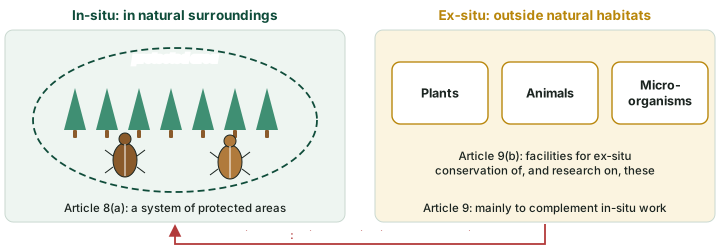
In India, NCERT names the main in-situ law: the Wild Life (Protection) Act, 1972, "under which national parks and sanctuaries were established and biosphere reserves declared". Each of these keeps species in their natural surroundings, so all three are in-situ measures in the CBD's sense.
In-situ and ex-situ conservation compared
| In-situ | Ex-situ | |
|---|---|---|
| Meaning (CBD Article 2) | Conserving ecosystems and habitats, and viable populations of species in their natural surroundings | Conserving components of biological diversity outside their natural habitats |
| Main tool in the CBD | Article 8(a): a system of protected areas | Article 9(b): facilities for plants, animals and micro-organisms |
| Relation between them | The measures that ex-situ work is meant to complement | Article 9: "predominantly for the purpose of complementing in-situ measures" |
| Return to the wild | Receives reintroduced species | Article 9(c): reintroduction of threatened species into their natural habitats |
| Indian law named by NCERT | Wild Life (Protection) Act, 1972: national parks, sanctuaries, biosphere reserves | None named in the NCERT chapter |
Sources: CBD, Article 2 "Use of Terms"; CBD, Article 8 "In-situ Conservation"; CBD, Article 9 "Ex-situ Conservation"; NCERT, Fundamentals of Physical Geography, Class XI, chapter 14 "Biodiversity and Conservation" (Reprint 2026-27).
The Convention on Biological Diversity and the global framework
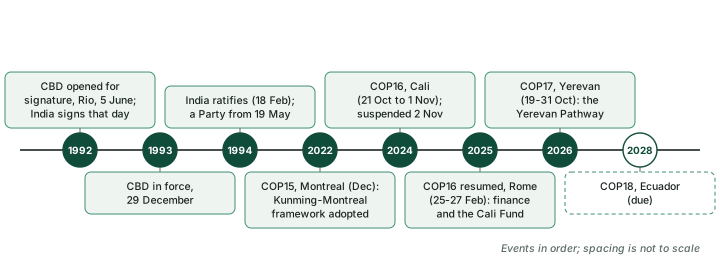
The CBD was opened for signature at the Rio Earth Summit on 5 June 1992. The CBD's own overview says it was "Signed by 150 government leaders at the 1992 Rio Earth Summit"; by 4 June 1993 it had 168 signatures, and it came into force on 29 December 1993. NCERT gives a third figure: "The Government of India along with 155 other nations have signed the Convention of Biodiversity at the Earth Summit held at Rio de Janeiro, Brazil in June 1992." The numbers count different things (leaders at Rio, signatures within a year, NCERT's own count), so each needs its basis. India signed on 5 June 1992, ratified on 18 February 1994 and became a Party on 19 May 1994. The CBD now has 196 Parties.
The convention works through its Conference of the Parties (COP). At COP15, in Montreal in December 2022, the Parties adopted the Kunming-Montreal Global Biodiversity Framework (KMGBF), with 4 goals for 2050 and 23 targets for 2030. Its best-known target, Target 3, aims to conserve at least 30% of land, inland waters, and coastal and marine areas by 2030.
COP16 met in Cali from 21 October to 1 November 2024 and was suspended early on 2 November for loss of quorum, leaving some agenda items unresolved. In Cali the Parties set up a mechanism for sharing the benefits from digital sequence information on genetic resources, including a Cali Fund to which companies in lucrative industries are now "expected to contribute either a portion of their revenue or their profits"; at least half the fund is meant for indigenous peoples and local communities. They also created a permanent subsidiary body on Article 8(j) and other provisions, meant to raise the role of indigenous peoples and local communities in implementing the Convention. The Cali Fund was launched in Rome in February 2025, in the margins of the resumed session (25-27 February 2025), which agreed a strategy for mobilising resources towards the KMGBF goal of at least US$200 billion a year by 2030, including international flows of US$20 billion a year by 2025, rising to US$30 billion by 2030. In between, IPBES-11, held in Windhoek, Namibia, from 10 to 16 December 2024, approved the summaries for policymakers of two new assessments: the nexus assessment, on the interlinkages among biodiversity, water, food and health, and the transformative change assessment, on the underlying causes of biodiversity loss.
COP17 met in Yerevan, Armenia, from 19 October 2026; scheduled to end on 30 October (CBD, Conference of the Parties meetings list), it concluded on 31 October (CBD press release, 31 Oct 2026 (COP17)), having adopted nearly 50 decisions. Its centrepiece, the Yerevan Pathway, responds to the first review of collective progress on the KMGBF, which found the world off track. The new Article 8(j) body's rules were "officially named the Sevan Guidelines", and nearly US$2 billion in new funding was announced (an announcement, not money yet spent). The CBD's closing statement was frank: "we are not yet on track to achieve our 2030 targets". COP18 is due to be held in Ecuador in 2028. The timeline below sets these events in order.
The terms compared
Key terms of this part compared
| Term | What it means | Applies to | Defined by |
|---|---|---|---|
| Biodiversity hotspot | At least 1,500 endemic plant species and at least 70% of original vegetation lost | A region (may cross borders) | CI, from Myers's concept |
| Megadiverse country | One of the 12 countries NCERT calls "mega diversity centres" | A country | NCERT's list |
| "Hotspots of diversity" (NCERT) | An area rich in species diversity | An area | NCERT (loose use) |
| Endemic | Found nowhere else on Earth | A species | CI page |
| Native | A natural inhabitant of the place | A species | The reverse of NCERT's exotic |
| Exotic | Not a natural inhabitant; introduced | A species | NCERT |
| Threatened | Critically Endangered, Endangered or Vulnerable | A species | IUCN Red List, as used by Mittermeier et al. (2011) |
| In-situ conservation | Conservation in natural surroundings | Ecosystems, habitats, populations | CBD Article 2 |
| Ex-situ conservation | Conservation outside natural habitats | Components of biodiversity | CBD Article 2 |
Sources: Conservation International, "Biodiversity hotspots" (page read 17 Nov 2026); NCERT, Fundamentals of Physical Geography, Class XI, chapter 14 "Biodiversity and Conservation" (Reprint 2026-27); Mittermeier et al. (2011), "Global biodiversity conservation: the critical role of hotspots", in F.E. Zachos and J.C. Habel (eds.), Biodiversity Hotspots (Springer, 2011); CBD, Article 2 "Use of Terms".
Exam tip
Learn each term with its unit and its source: is it a country, a region or a species, and who defines it? Then learn each figure with its date and its basis, as with the two Madagascar figures and the two hotspot area figures: a number without its basis is easy to misuse.
Summary
- Biodiversity has three levels: genetic (within species), species (between species) and ecosystem (of ecosystems), in both NCERT and CBD Article 2.
- Endemic means found nowhere else on Earth; native means a natural inhabitant of the place; exotic means introduced from elsewhere.
- NCERT estimates 2 to 100 million species (best estimate 10 million); IPBES (2019) estimates about 8 million, including 5.5 million insects, with around 1 million threatened with extinction.
- A megadiverse country is a nation (NCERT lists 12, India among them); a hotspot is a region with at least 1,500 endemic plant species and at least 70% of its original vegetation lost.
- The hotspot count rose from 10 (Myers, 1988) to 18 (1990), 25 (1999-2000), 34 (2004), 35 (2011) and 36 (2016). The concept is Myers's; the list is CI's.
- India has parts of four hotspots: Himalaya, Indo-Burma (with the Andamans), Western Ghats and Sri Lanka, and Sundaland (with the Nicobars).
- IPBES ranks five direct drivers: land and sea use change, direct exploitation, climate change, pollution and invasive alien species.
- The IUCN Red List has nine categories, not NCERT's three; on 9 July 2026 it counted 49,505 threatened species among 175,909 assessed.
- In-situ conservation keeps species in their natural surroundings; ex-situ keeps them outside, mainly to complement in-situ work.
- The CBD (1992; in force 1993; 196 Parties) adopted the KMGBF in 2022; COP16 (Cali 2024, Rome 2025) and COP17 (Yerevan 2026) followed, with COP18 due in Ecuador in 2028.
Sources
Each table and data figure names its source beneath it. The main documents are collected here, with a date where the source carries one. Figures not listed under image credits were drawn for this page from the sources stated in their source lines.
Main sources
Image credits
| Image | Credit and licence |
|---|---|
| Evergreen forest, Makutta Range, Western Ghats, Karnataka | Rohitjahnavi, 5 November 2026. CC0. File page |
| Grasslands with pockets of montane shola forest in the Nilgiris, Tamil Nadu | Anand Osuri, February 2009. CC BY-SA 4.0. File page |
| A lion-tailed macaque in Anaimalai National Park, Tamil Nadu | Amitayu, 26 July 2013. CC BY-SA 4.0. File page |
| All other figures | Drawn for this page from the sources given in their source lines. |