 BharatNotes
Part 2 of 9 of the Geomorphology and Landforms notes. The overview page has the quick revision, exam strategy and key terms for all nine parts.
Geomorphic Processes and Weathering
Two sets of forces shape the surface of the earth. Forces from inside the earth raise and break the crust; forces from outside, driven by the sun, wear it down. This part sets out that framework in NCERT's own terms and then looks at the first of the wearing-down processes, weathering: the chemical, physical and biological breakdown of rock in place. It ends with exfoliation, which NCERT is careful to call a result rather than a process, and with why weathering matters for soils, ores and every landform that follows.
Two sets of forces
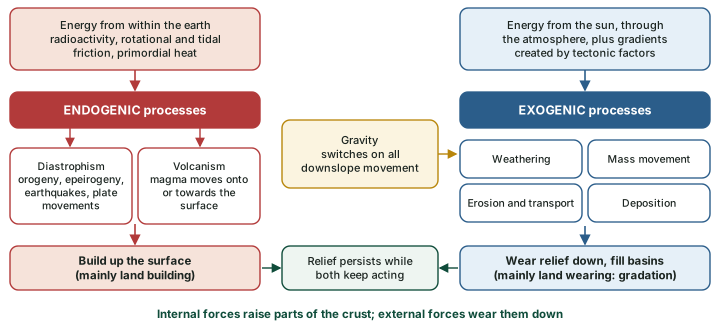
The surface of the earth is acted on continuously by two kinds of force (NCERT). Endogenic forces come from within the earth. Exogenic forces originate in the atmosphere and are driven basically by the energy of sunlight. Exogenic forces wear down the high ground (degradation) and fill up basins and depressions (aggradation). NCERT calls the wearing down of relief through erosion gradation. If that were all, the surface would in time be worn flat; it is not, because endogenic forces keep raising parts of the crust. "So, variations remain as long as the opposing actions of exogenic and endogenic forces continue." In NCERT's summary, "the endogenic forces are mainly land building forces and the exogenic processes are mainly land wearing forces" (NCERT, Fundamentals of Physical Geography, Class XI (reprint 2026-27), ch 5).
Remember
NCERT spells the terms endogenic and exogenic. Some books write endogenetic and exogenetic; they mean the same thing.
Geomorphic processes and agents
The endogenic and exogenic forces that cause physical stresses and chemical actions on earth materials, and so change the configuration of the surface, are called geomorphic processes. Diastrophism and volcanism are the endogenic processes; weathering, mass wasting, erosion and deposition are the exogenic ones (NCERT).
A geomorphic agent is any exogenic element of nature, such as water, ice or wind, that can acquire and transport earth materials. NCERT draws the line clearly: "A process is a force applied on earth materials affecting the same. An agent is a mobile medium (like running water, moving ice masses, wind, waves and currents etc.) which removes, transports and deposits earth materials." The agents of these notes are running water, groundwater, glaciers, wind, and waves and currents; parts 4 to 8 take them one at a time: running water, groundwater, glaciers, waves and currents and wind.
Key idea: Gravity and gradients
Gravity is not an agent, but nothing moves without it. NCERT calls it "the force that switches on the movement of all surface material on earth". All movement follows a gradient, from higher to lower levels or from high to low pressure; "without gravity and gradients there would be no mobility and hence no erosion, transportation and deposition".
Endogenic processes
The energy behind endogenic processes is "mostly generated by radioactivity, rotational and tidal friction and primordial heat from the origin of the earth" (NCERT). Through geothermal gradients and heat flow from within, it drives diastrophism and volcanism. Because geothermal gradients, heat flow, and the thickness and strength of the crust all vary from place to place, endogenic forces act unevenly, and the tectonically controlled original surface of the crust is uneven.
Diastrophism
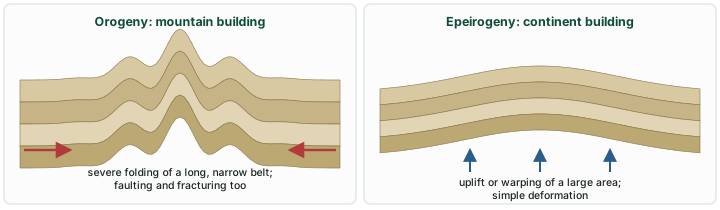
All processes that move, elevate or build up portions of the crust come under diastrophism. NCERT lists four:
- Orogenic processes: mountain building through severe folding, affecting long and narrow belts of the crust.
- Epeirogenic processes: uplift or warping of large parts of the crust.
- Earthquakes: local, relatively minor movements.
- Plate tectonics: horizontal movements of crustal plates.
In orogeny the crust is severely deformed into folds; epeirogeny may cause only simple deformation. Through orogeny, epeirogeny, earthquakes and plate tectonics "there can be faulting and fracturing of the crust" (NCERT). All of these processes cause pressure, volume and temperature changes, which in turn induce the metamorphism of rocks described in rocks and the rock cycle.
Orogeny and epeirogeny
| Orogeny | Epeirogeny | |
|---|---|---|
| NCERT's one-line definition | A mountain building process | A continental building process |
| What happens | Severe folding of the crust | Uplift or warping |
| Area affected | Long and narrow belts | Large parts of the crust |
| Deformation | Severe: folds, with faulting and fracturing | May be simple |
Source: NCERT, Fundamentals of Physical Geography, Class XI (reprint 2026-27), ch 5.
Faulting shows clearly in Peninsular India. NCERT's India volume describes the Peninsula as a rigid block that has undergone vertical movements and block faulting, and names the rift valleys of the Narmada, the Tapi and the Mahanadi and the Satpura block mountains as examples (NCERT, India: Physical Environment, Class XI (reprint 2026-27), ch 2). NCERT's term is "block mountain"; the international term for such a block is "horst".
Volcanism and plate movements
Volcanism covers the movement of molten rock (magma) onto or towards the surface and the formation of intrusive and extrusive volcanic forms (NCERT). Volcanism, earthquakes and plate tectonics are treated in full in the Plate Tectonics and Volcanism notes; these notes take the uneven surface they leave as their starting point.
Exogenic processes and denudation
Exogenic processes take their energy from the atmosphere, which is powered ultimately by the sun, and from the gradients that tectonic factors create (NCERT). Gravity acts on every sloping surface and pulls material downslope. Force applied per unit area is stress; forces acting along the faces of earth materials are shear stresses, and "it is this stress that breaks rocks and other earth materials". Earth materials also suffer molecular stresses, most commonly from temperature changes, crystallisation and melting, while chemical processes loosen the bonds between grains and dissolve soluble minerals or cementing materials. "Thus, the basic reason that leads to weathering, mass movements, and erosion is development of stresses in the body of the earth materials" (NCERT).
All the exogenic processes come under one general term, denudation. "The word 'denude' means to strip off or to uncover." Weathering, mass wasting or movement, erosion and transportation are all part of denudation (NCERT).
What controls the rate: climate, then rock
Temperature and precipitation are the two climatic elements that matter most. Because climates differ with latitude, season, and the spread of land and water, exogenic processes differ from region to region. Within one climatic region they still vary with altitude, with aspect (north- and south-facing slopes receive different amounts of insolation from east- and west-facing ones), and with wind, the kind and intensity of precipitation, the daily range of temperature, the frequency of freezing and thawing and the depth of frost penetration. Vegetation, which depends on precipitation and temperature, also has a say (NCERT).
"Climatic factors being equal, the intensity of action of exogenic geomorphic processes depends upon type and structure of rocks" (NCERT). Structure here means folds, faults, the orientation and inclination of beds, joints and bedding planes, the hardness and chemical susceptibility of the minerals, and permeability. A rock may resist one process and give way to another, so processes work at different rates and the topography that results is uneven. Most exogenic processes are small and slow, but over the long run "continued fatigue" tells on the rocks.
Weathering
NCERT defines weathering as "mechanical disintegration and chemical decomposition of rocks through the actions of various elements of weather and climate". The key word is in situ: "As very little or no motion of materials takes place in weathering, it is an in-situ or on-site process." Any small movement that happens during weathering is not transportation; carrying the material away is the job of mass movement and the agents of erosion (see mass movement, erosion and deposition).
Weathering is controlled by geological, climatic, topographic and vegetative factors, and climate is of particular importance: "Not only weathering processes differ from climate to climate, but also the depth of the weathering mantle" (NCERT). NCERT illustrates this with a profile adapted from Strakhov (1967), redrawn below as a schematic.
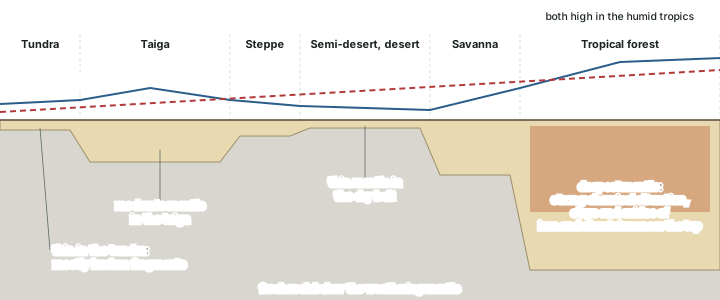
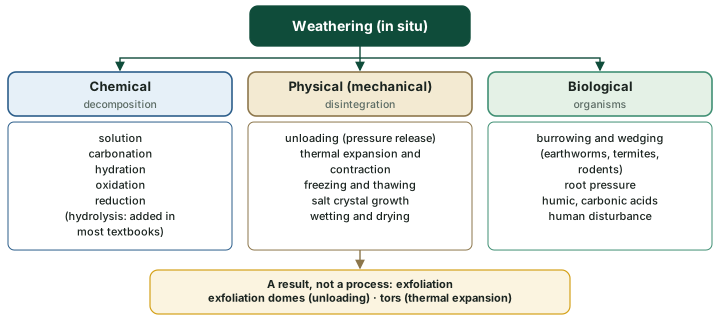
There are three groups of weathering processes: chemical, physical (mechanical) and biological. "Very rarely does any one of these processes ever operate completely by itself, but quite often a dominance of one process can be seen" (NCERT).
Chemical weathering
Chemical weathering decomposes, dissolves or reduces rock "to a fine clastic state through chemical reactions by oxygen, surface and/or soil water and other acids". NCERT names five processes: solution, carbonation, hydration, oxidation and reduction. Water and air (oxygen and carbon dioxide), along with heat, must be present to speed up the reactions. Underground, the decay of plants and animals adds carbon dioxide to what the air already holds (NCERT).
Chemical weathering processes
| Process | What happens | Example or effect |
|---|---|---|
| Solution | Soluble minerals, or the cement between grains, dissolve in water | Loosens the bonds between grains (NCERT) |
| Carbonation | Carbon dioxide dissolved in water forms a weak carbonic acid that attacks carbonate rock | Limestone and dolomite dissolve; karst landforms follow (see karst landforms) |
| Hydration | A mineral takes water into its structure | Anhydrite becomes gypsum |
| Oxidation | Minerals combine with oxygen | Iron oxides give many tropical soils their red-brown colour |
| Hydrolysis (not in NCERT's list) | A decomposition reaction involving water, frequently of silicate minerals | Feldspar breaks down to clay (kaolinite) |
Source: NCERT, Fundamentals of Physical Geography, Class XI (reprint 2026-27), ch 5; NPS glossary: oxidation, hydrolysis, chemical weathering.

Remember: The carbonation exception
Temperature works in two ways. NCERT: "Chemical activity is increased in higher temperatures, reduced in cooler temperatures (with an exception of carbonation) and stops in freezing conditions." Carbonation is the one chemical process that does not slow down in the cold. Chemical weathering as a whole is fastest where it is hot and wet.
Physical weathering
Physical or mechanical weathering breaks rock without changing its composition. NCERT says it depends on applied forces of three kinds: (i) gravitational forces such as overburden pressure, load and shearing stress; (ii) expansion forces due to temperature changes, crystal growth or animal activity; and (iii) water pressures controlled by wetting and drying cycles. "Most of the physical weathering processes are caused by thermal expansion and pressure release." Each event is small, but the repetition of expansion and contraction fatigues the rock until it fails (NCERT).
Physical weathering processes
| Process | Force at work (NCERT group) | What it does |
|---|---|---|
| Unloading (pressure release) | Gravitational: removal of overburden | Rock once buried expands as the load above is eroded and splits along curved sheets, like the skins of an onion (NPS) |
| Thermal expansion and contraction | Expansion: temperature change | Repeated heating and cooling fatigues the outer layers until they crack and flake |
| Freezing and thawing (frost) | Expansion: crystal growth of ice | Ice growing in joints and pores pries the rock apart; it works by repetition |
| Salt crystal growth | Expansion: crystal growth | Salt crystals growing in pores push the grains apart |
| Wetting and drying | Water pressure | Repeated wetting and drying cycles stress the rock |
Source: NCERT, Fundamentals of Physical Geography, Class XI (reprint 2026-27), ch 5; NPS glossary: exfoliation, frost wedging, mechanical weathering.
Frost: what actually splits the rock?
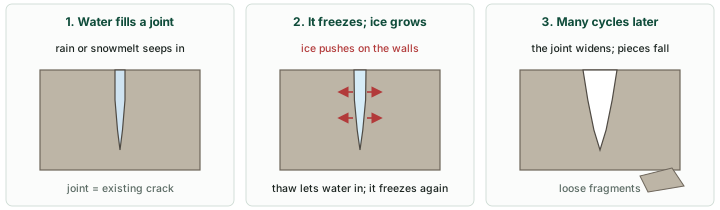
Frost wedging is "a type of frost action by which jointed rock is pried and dislodged by ice acting as a wedge" (NPS glossary). Its power comes from repetition: "it is the successive freezing and thawing that eventually weathers rocks down, rather than one single episode of freezing", so it is most active where freezing and thawing alternate often, such as mountain tops. It is weak beneath polar ice sheets, which stay frozen, in cold deserts, which have too little water, and in hot deserts, which are seldom cold enough (Earthlearningidea: Ice power).
Hypothesis: Frost weathering, textbook account and research
The usual account. Water expands by about 9 per cent when it freezes, and the expanding ice forces the crack open. A classroom test with a syringe of water in a freezer gives about this figure (Earthlearningidea).
What research finds. Vlahou and Worster (2010, Journal of Glaciology) modelled ice growing in a cavity in porous rock. They note that if expansion did the work, rock would not fracture unless its pores were at least about 91 per cent full of water, which experiments do not support. In most rocks the pressure from expansion leaks away as water is pushed out through the pores; "the effect of expansion is negligible in most cases". The larger stress comes later, from thin films of water between the ice and the rock that keep drawing water to the growing ice, the process behind ice segregation. Expansion can still matter in very impermeable rock such as granite (Vlahou and Worster 2010).
For the exam: the expansion explanation is the standard textbook answer; ice segregation is the research view.
Biological weathering
NCERT defines biological weathering as the contribution or removal of minerals and ions from the weathering environment, and the physical changes caused by the growth or movement of organisms. Its examples:
- Burrowing and wedging by earthworms, termites, rodents and others expose new surfaces to chemical attack and let moisture and air penetrate.
- Human beings, by disturbing vegetation and by ploughing and cultivating soils, mix the materials and create new contacts between air, water and minerals.
- Decaying plant and animal matter produces humic, carbonic and other acids that speed up decay and the solution of some elements.
- Plant roots "exert a tremendous pressure on the earth materials mechanically breaking them apart".
Biological weathering is therefore partly chemical (the acids) and partly physical (roots and burrows); NCERT treats it as a group of its own.
Exfoliation: a result, not a process
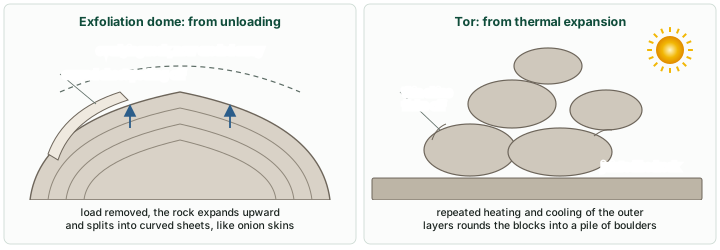
Exfoliation is the flaking off of more or less curved sheets or shells from rock or bedrock, which leaves smooth, rounded surfaces. NCERT is precise about its status: "Exfoliation is a result but not a process." It is produced by the physical processes already described: unloading, thermal contraction and expansion, and salt weathering. NCERT ties the two best-known landforms to different causes: "Exfoliation domes and tors result due to unloading and thermal expansion respectively." NPS defines exfoliation the same way, as spalling or flaking of layers "caused by a change in heat or a reduction in pressure when overlying rocks erode away" (NPS glossary).
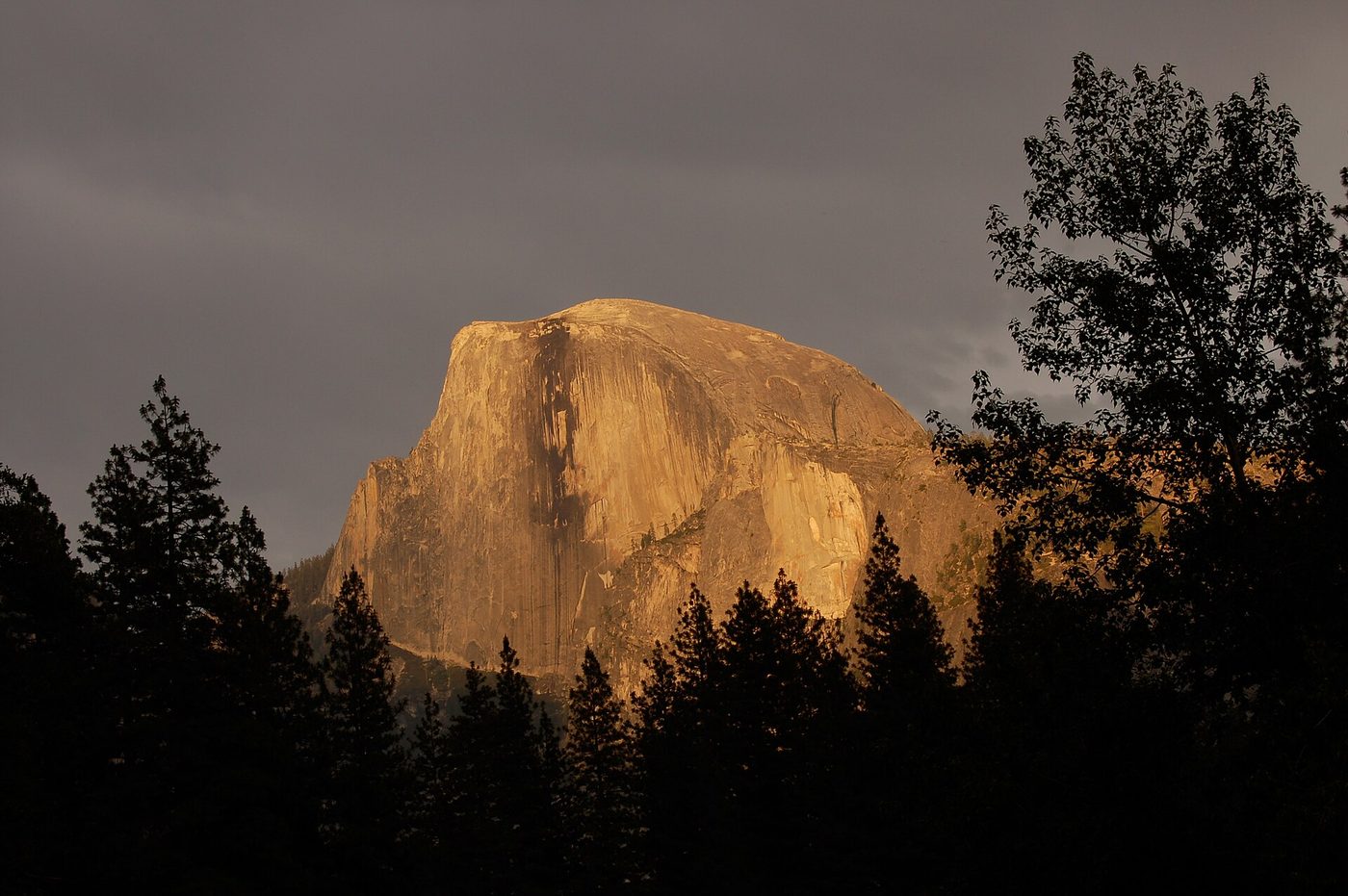
Half Dome in Yosemite National Park, California, shows the dome form and its limits. Its granite cooled slowly deep below a chain of volcanoes; over tens of millions of years the volcanoes were eroded away, removing a great weight, and the granite rose to the surface. The summit "was never overtopped by glaciers, so its rounded shape results from a different kind of erosion called exfoliation", in which "slabs of rock break and peel away along curving parallel fractures similar to the skins of an onion". The sheer face has another origin: a large vertical fracture that glaciers exploited. On that face, exfoliation still causes rockfalls every few years (NPS: Formation of Half Dome).
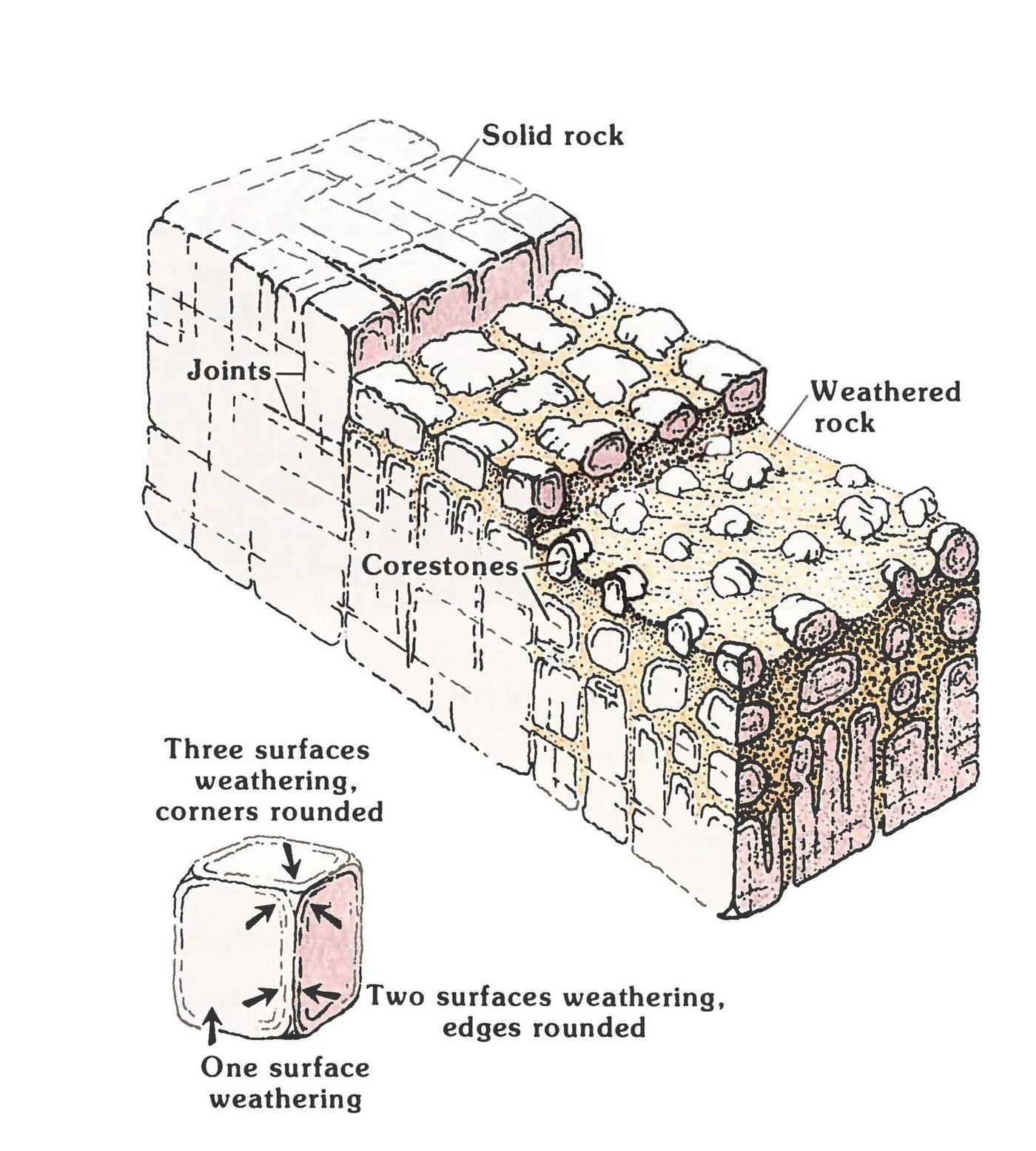
Rounding also starts underground, along joints. The block diagram below, from a US Geological Survey account of Yosemite, shows why: weathering attacks the corners and edges of a joint block from two or three sides at once, but a flat face from only one, so the corners go first and rounded corestones are left inside the weathered rock. In India, NCERT lists tors among the landforms of the Peninsular plateau.
Why weathering matters
- Regolith and soil. Weathering breaks rock into smaller fragments and so prepares the way for regolith and soils. "Weathering is an important process in the formation of soils" (NCERT).
- Mass movement and erosion. Weathering aids both: "Erosion cannot be significant if the rocks are not weathered." But NCERT also says weathering "is not a pre-requisite for mass movement though it aids mass movements" (see mass movement, erosion and deposition).
- Biomes. Biomes and biodiversity rest on forests, and "forests depend upon the depth of weathering mantles".
- Ores. Weathering helps enrich and concentrate valuable ores of iron, manganese, aluminium, copper and others. Leaching by groundwater removes some materials, so the concentration of what remains rises; without it, the deposit may not be rich enough to mine economically. NCERT calls this enrichment.
Don't confuse: Weathering, mass movement, erosion
Weathering happens in place. Mass movement moves weathered (or unweathered) material downslope under gravity alone. Erosion picks material up and carries it away with an agent such as running water, ice or wind. The same boulder can be weathered on a cliff, fall in a rockfall and then be carried off by a river: three different processes.
Summary
- Endogenic forces, powered from within the earth, build the surface up; exogenic forces, powered by the sun, wear it down. Relief persists while both act.
- Diastrophism (orogeny, epeirogeny, earthquakes, plate movements) and volcanism are the endogenic processes; weathering, mass wasting, erosion and deposition are the exogenic ones, grouped as denudation.
- A process is a force; an agent is a mobile medium. Gravity switches on all downslope movement.
- Weathering is in situ breakdown by chemical, physical and biological processes. Climate sets both the processes and the depth of the weathered mantle; rock type and structure set the rate.
- Chemical activity rises with temperature, except carbonation. Most physical weathering comes from thermal expansion and pressure release; frost works by repetition.
- Exfoliation is a result: domes from unloading, tors from thermal expansion (NCERT).
The three groups of weathering compared
| Chemical | Physical | Biological | |
|---|---|---|---|
| What changes | Mineral composition: rock decomposes or dissolves | Size only: rock breaks, composition unchanged | Both, through living things |
| NCERT's processes | Solution, carbonation, hydration, oxidation, reduction | Gravitational, expansion and water-pressure forces; thermal expansion and pressure release above all | Burrowing, wedging, root pressure, organic acids, human activity |
| Favoured by | Heat and water; carbonation also in the cold | Repeated temperature change; frequent freezing and thawing | Plant and animal life; disturbed soils |
| Typical products | Clays, oxides, dissolved limestone, deep tropical mantles | Fragments, curved sheets, tors | Mixed, aerated soil with organic acids |
Source: NCERT, Fundamentals of Physical Geography, Class XI (reprint 2026-27), ch 5; Earthlearningidea: Ice power (freeze-thaw).
Sources
Each table and data figure names its source beneath it. The main documents are collected here, with a date where the source carries one. Figures not listed under image credits were drawn for this page from the sources stated in their source lines.
Main sources
| Topic | Source |
|---|---|
| Textbooks | NCERT, Fundamentals of Physical Geography, Class XI (reprint 2026-27), ch 5, and ch 6 (groundwater); NCERT, India: Physical Environment, Class XI (reprint 2026-27), ch 2 |
| Definitions of weathering terms | NPS: glossary of geologic terms |
| Frost weathering | Vlahou and Worster (2010), Journal of Glaciology; Earthlearningidea: Ice power |
| Half Dome and exfoliation | NPS: Formation of Half Dome |
| Joint blocks and corestones | N.K. Huber, 1987, The geologic story of Yosemite National Park, U.S. Geological Survey |
Image credits
| Image | Credit and licence |
|---|---|
| Half dome at sunset in Yosemite National Park | NPS / Damon Joyce, 25 June 2006. Public domain. File page |
| Weathering of joint blocks and stages in the formation of corestones | United States Geological Survey, Reston, Virginia, 30 June 1987. Public domain. File page |
| All other figures | Drawn for this page from the sources given in their source lines. |