 BharatNotes
Part 1 of 9 of the Geomorphology and Landforms notes. The overview page has the quick revision, exam strategy and key terms for all nine parts.
Rocks and the Rock Cycle
Every landform in these notes is carved out of rock, so the notes start with what rock is. This part goes from the elements of the crust to the minerals they build, and from minerals to the three families of rock: igneous, sedimentary and metamorphic. It ends with the rock cycle, the loop that turns each family into the others. NCERT dropped its "Minerals and Rocks" chapter from the current Class XI book, so the 2020 edition is the textbook source here, checked against the US National Park Service (NPS) geology pages.
What the crust is made of
About 98 per cent of the earth's crust is made of just eight elements: oxygen, silicon, aluminium, iron, calcium, sodium, potassium and magnesium. The remaining 2 per cent is titanium, hydrogen, phosphorus, manganese, sulphur, carbon, nickel and other elements (NCERT). These elements are rarely found alone. They combine with one another into substances called minerals, and minerals in turn make up rocks. The order matters for the rest of these notes: elements build minerals, minerals build rocks, and rocks are what weathering, mass movement and the agents of erosion work on.
- ~98% of the crust is eight elements, led by oxygen and silicon (NCERT).
- 2,000+ minerals named and identified in the crust (NCERT).
- 3 rock families, grouped by how they form: igneous, sedimentary, metamorphic.
Silicon and oxygen dominate because almost all igneous rocks are silicates, and NPS lists the same eight elements, in descending order, as the main ingredients of igneous rock (NPS: igneous rocks).
Minerals
NCERT defines a mineral as "a naturally occurring organic and inorganic substance, having an orderly atomic structure and a definite chemical composition and physical properties". Most minerals contain two or more elements, but some are single elements: sulphur, copper, silver, gold and graphite. At least 2,000 minerals have been named, yet "almost all the commonly occurring ones are related to six major mineral groups that are known as major rock forming minerals" (NCERT).
Don't confuse: Mineral in NCERT and in geology
NCERT's definition says "organic and inorganic". The geological definition used by NPS is narrower: "A naturally occurring inorganic crystalline solid with a definite chemical composition or compositional range" (NPS glossary: mineral). NCERT also describes coal, petroleum and natural gas as minerals that are "organic substances". For an NCERT-based objective question, follow NCERT; for a definition in an answer, the inorganic, crystalline wording is the standard one.
The source of all minerals, in NCERT's words, is the hot magma of the interior: as magma cools, crystals appear and a series of minerals forms in sequence until the melt has solidified into rock.
Physical characteristics
Minerals are told apart by ten physical characteristics. Two of them are often confused. Colour can mislead, because impurities colour some minerals (quartz may be white, green, red or yellow). Streak, the colour of the mineral's powder, is steadier: fluorite is purple or green but gives a white streak.
The ten physical characteristics of minerals
| Property | What it means | NCERT example |
|---|---|---|
| Crystal form | External shape set by the internal arrangement of molecules | Cubes, octahedrons, hexagonal prisms |
| Cleavage | Tendency to break along given directions into relatively plane surfaces | May cleave in one or more directions |
| Fracture | Irregular breakage where there are no planes of molecules | Breaks not along cleavage planes |
| Lustre | Appearance of the surface regardless of colour | Metallic, silky, glossy |
| Colour | Set by molecular structure, or by impurities | Malachite, azurite, chalcopyrite; quartz in many colours |
| Streak | Colour of the ground powder | Malachite: green streak; fluorite: white streak |
| Transparency | Transparent, translucent or opaque | Light passes, diffuses, or does not pass |
| Structure | Arrangement of individual crystals | Fine, medium or coarse grained; fibrous |
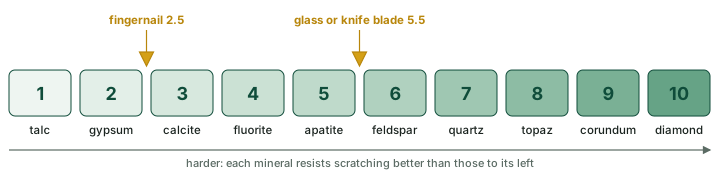
| Hardness | Relative resistance to being scratched | Mohs scale, 1 (talc) to 10 (diamond) |
| Specific gravity | Weight of the object divided by the weight of an equal volume of water | Weigh in air, then in water |
Source: NCERT, Fundamentals of Physical Geography, Class XI, 2020 edition, ch 5 (dropped from the current book).
Hardness is measured against ten reference minerals. A fingernail rates 2.5 and glass or a knife blade 5.5, so a mineral a fingernail can scratch is softer than 2.5, and one that scratches glass is harder than 5.5.
Metallic and non-metallic minerals
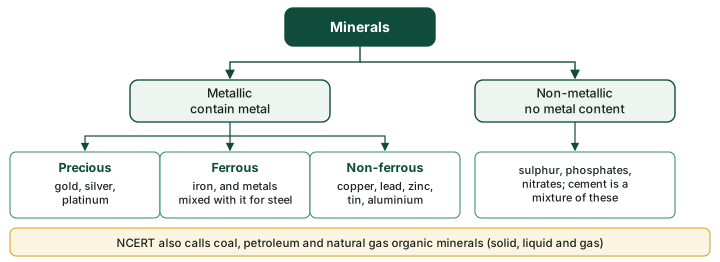
NCERT sorts economic minerals by whether they contain metal. Metallic minerals are precious (gold, silver, platinum), ferrous (iron, and metals mixed with iron to make steel) or non-ferrous (copper, lead, zinc, tin, aluminium). Non-metallic minerals such as sulphur, phosphates and nitrates contain no metal; cement is a mixture of non-metallic minerals.
The common rock-forming minerals
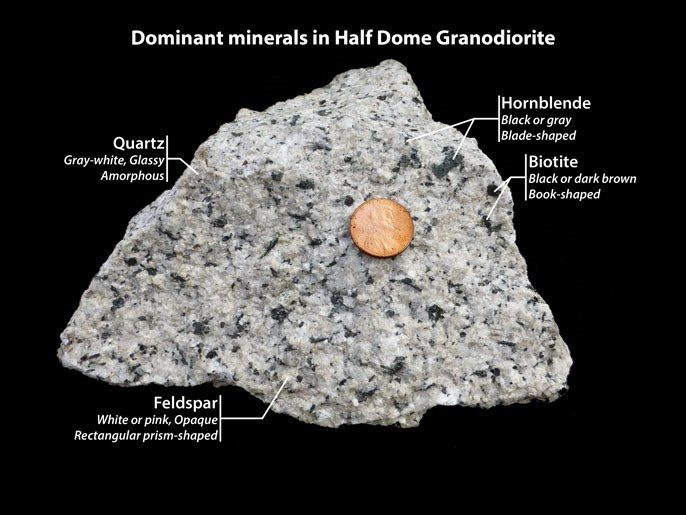
NCERT says feldspar and quartz are "the most common minerals found in rocks". The NPS igneous-rock page names the rest of the usual cast. Silicic rocks are mostly feldspars and quartz, with minor mica (biotite or muscovite) and amphibole. Mafic rocks carry minerals rich in magnesium and iron, such as olivine, pyroxene and amphibole, along with plagioclase feldspar; quartz cannot form in mafic magma, so it is absent from gabbro and basalt (NPS: igneous rocks).
Rocks and petrology
"A rock is an aggregate of one or more minerals" (NCERT). Rocks have no fixed mineral recipe, and they vary widely: granite is hard and soapstone soft; gabbro is black and quartzite can be milky white. The study of rocks is petrology, which covers their mineral composition, texture, structure, origin, occurrence, alteration and relationship with other rocks. NCERT's reason for a geographer to care is short: there is "a close relation between rocks and landforms, rocks and soils".
Rocks are grouped into three families by their mode of formation: igneous rocks solidify from magma and lava; sedimentary rocks result from the deposition of rock fragments by exogenous processes; metamorphic rocks form when existing rocks recrystallise (NCERT).
Igneous rocks
Igneous rocks form when magma cools and solidifies. The name comes from the Latin ignis, fire, and NPS calls them "fire-born" (NPS). Because they form directly from magma and lava from the interior, NCERT calls them primary rocks: the other two families are made, in the end, from them. Molten rock is called magma while it is underground and lava once it erupts at the surface.
Intrusive and extrusive: the cooling rate sets the grain size
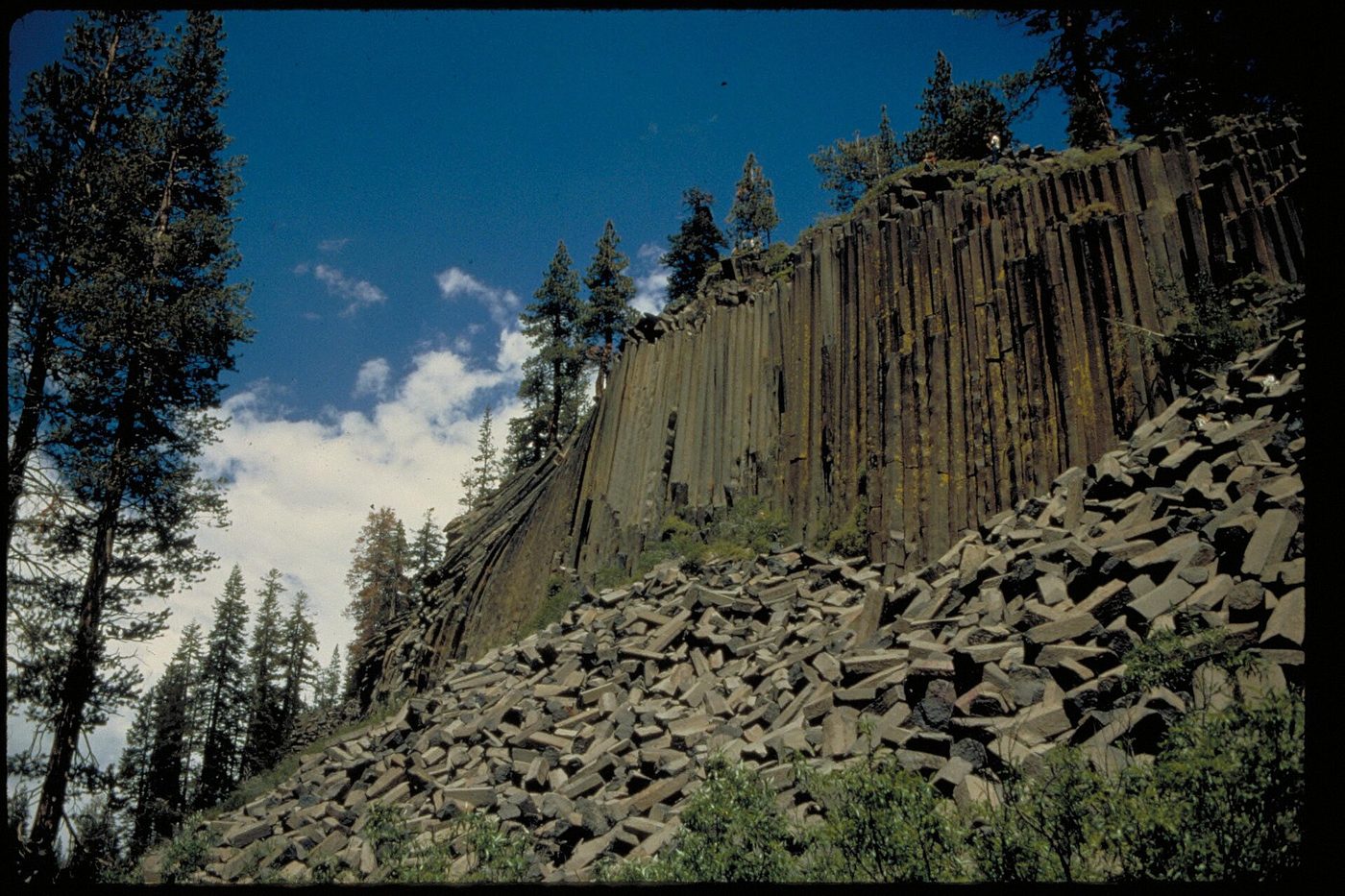
NCERT classifies igneous rocks by texture, which depends on the size and arrangement of grains. Magma that cools slowly at great depth grows large mineral grains; sudden cooling at the surface gives small, smooth grains; intermediate cooling gives intermediate grain sizes. NPS uses the same split. Intrusive rocks solidify within the earth and are also called plutonic rocks, after Pluto, the Roman god of the underworld; they are generally wholly crystalline, with crystals visible to the naked eye because they cool slowly. Extrusive rocks are erupted onto the surface and are also called volcanic rocks, after Vulcan; they usually have a very fine-grained or glassy groundmass from rapid cooling (NPS: igneous rocks). Obsidian is the extreme case, a volcanic glass (NPS glossary: obsidian).
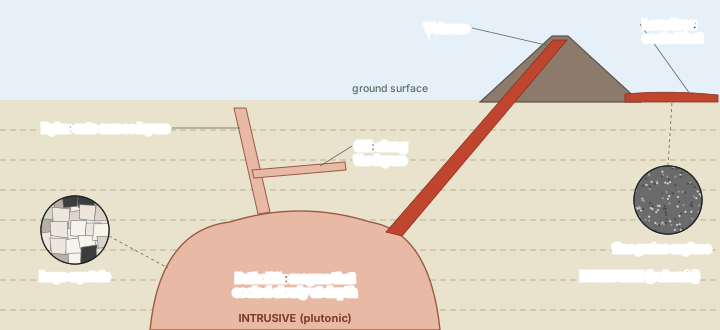
The shapes that intrusive magma takes underground (batholiths, sills, dykes and the rest) and the volcanic landforms built at the surface are the subject of the volcanoes and volcanic landforms parts of the Plate Tectonics and Volcanism notes; here only the rock matters. NCERT spells the vertical sheet "dyke"; American sources such as NPS spell it "dike".
Mafic and silicic: the silica content
The second way to classify igneous rock is by chemistry. Composition is expressed as the weight per cent of silica (SiO2), which ranges from about 45 to 78. Low-silica rocks are richer in iron and magnesium; high-silica rocks have less iron and magnesium and more sodium and potassium. NPS sets three bands: mafic (45-52 per cent silica), intermediate (52-66) and silicic (over 66). Mafic comes from magnesium and ferric (iron) and describes rock rich in dark minerals; felsic, from feldspar and silica, describes rock rich in light minerals such as quartz and feldspar (NPS glossary: mafic, felsic). Indian textbooks often use the older pair basic and acid for the same idea; NPS notes that "basic, acidic, felsic" are older terms that many American geologists no longer use.
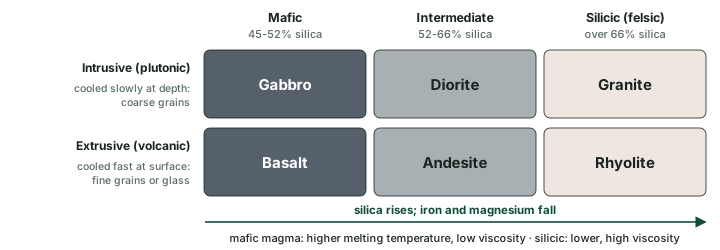
NCERT's own examples of igneous rocks are granite, gabbro, pegmatite, basalt, volcanic breccia and tuff. Pegmatite is an intrusive rock of exceptionally coarse, interlocking crystals, usually granitic, found in dykes, lenses and veins; tuff is consolidated volcanic ash (NPS glossary). Basalt is dark grey to black, has about 53 per cent silica or less, and is rich in iron and magnesium; granite is coarse-grained, intrusive and felsic (NPS glossary).
Sedimentary rocks
"Sedimentary" comes from the Latin sedimentum, settling (NCERT). Rocks of all three families exposed at the surface are broken into fragments by the agents of denudation; the fragments are transported and deposited, and the deposits turn into rock through compaction. The conversion of loose sediment into solid rock is called lithification (NCERT; NPS glossary: lithification). NPS adds that sediment buried deeply "becomes compacted and cemented" (NPS: sedimentary rocks). Sedimentary rocks cover most of the land surface but make up only a small part of the crust's volume.
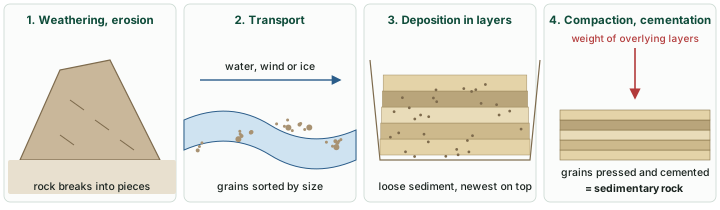
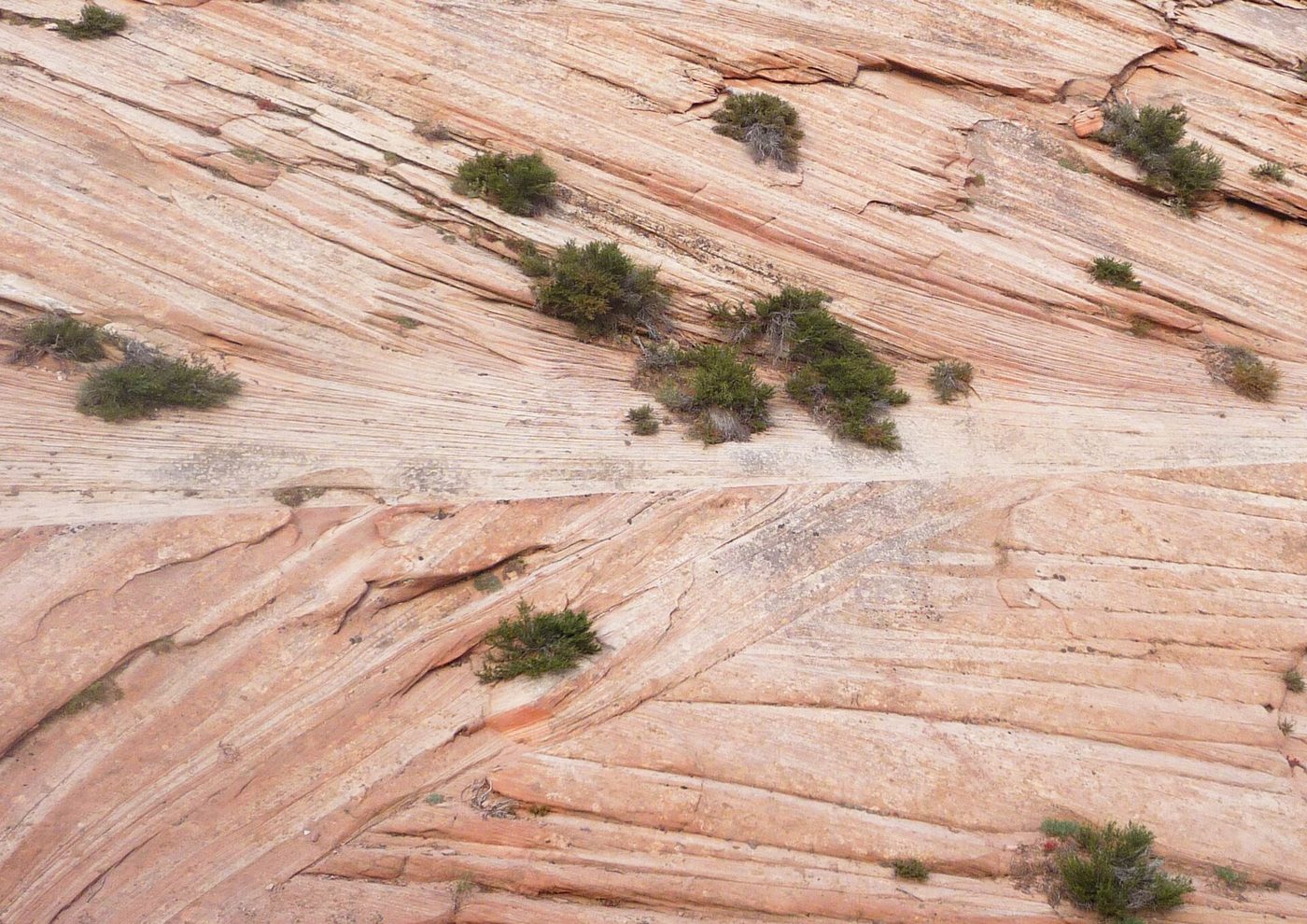
The layering survives lithification, which is why sandstone, shale and other sedimentary rocks show layers of varying thickness (NCERT). NPS calls this "distinctive layering or bedding". The layers record the order of deposition, newest on top, and they can preserve the remains of once-living organisms.
Three groups by mode of formation
NCERT divides sedimentary rocks into three groups by how they form. NPS uses the same three under the names clastic, biologic and chemical (NPS: sedimentary rocks). Clastic grains are graded by size: the smallest are clay, then silt, then sand, and grains larger than 2 mm are pebbles. Shale is made of clay-sized particles and splits easily (fissility); conglomerate is made of cemented, rounded clasts larger than 2 mm (NPS glossary).
The three groups of sedimentary rocks
| Group (NCERT) | NPS name | How it forms | Examples |
|---|---|---|---|
| Mechanically formed | Clastic | Pieces of older rock, loosened by weathering, are deposited and cemented | Sandstone, conglomerate, shale, loess (NCERT also lists limestone) |
| Organically formed | Biologic | Remains of living things accumulate | Coal (plant material), chalk, limestone, geyserite (NCERT); coquina (NPS) |
| Chemically formed | Chemical | Minerals dissolved in water precipitate out, for example as the water evaporates | Chert, halite, potash, limestone (NCERT); gypsum in evaporites (NPS) |
Source: NCERT, Fundamentals of Physical Geography, Class XI, 2020 edition, ch 5 (dropped from the current book); NPS: sedimentary rocks.
Remember
NCERT places limestone in all three groups. That is not a slip: limestone can form from fragments, from shells and skeletons, or by precipitation. Limestone matters later in these notes because it dissolves; the part on karst landforms shows the landforms that result.
Metamorphic rocks
"Metamorphic" means "change of form". Metamorphic rocks form when existing rocks are changed by pressure, volume and temperature (PVT) changes (NCERT). That happens when rocks are forced down to lower levels by tectonic processes, when rising magma comes into contact with crustal rocks, or when underlying rocks are squeezed by the weight of rocks above. In the process, already consolidated rock recrystallises and its materials are reorganised (NCERT). NPS gives the same idea: "high temperatures and pressure act on a rock to alter its physical and chemical properties" (NPS: metamorphic rocks).
Dynamic and thermal metamorphism
- Dynamic metamorphism: the original minerals are broken, crushed and reorganised mechanically, without any appreciable chemical change.
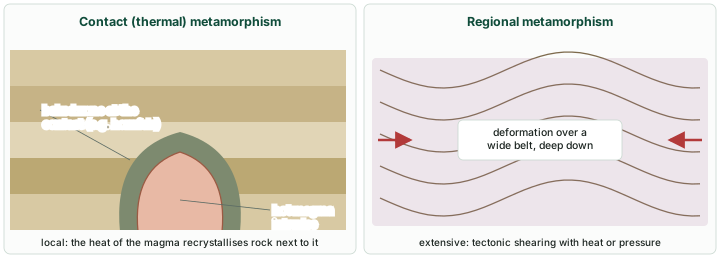
- Thermal metamorphism: the materials alter chemically and recrystallise. It is of two kinds. In contact metamorphism rocks touching hot intruding magma or lava recrystallise under high temperature, and new material from the magma is often added. In regional metamorphism rocks recrystallise because of deformation by tectonic shearing together with high temperature or pressure or both (NCERT).
The difference is one of scale. NPS describes contact metamorphism as "local" and confined to rocks "at or near their contact with a body of igneous rock", while regional metamorphism "affects an extensive region" (NPS: metamorphic rocks). Hornfels, a fine-grained rock with no preferred grain orientation, typically forms by contact metamorphism (NPS glossary: hornfels).
Foliation and banding
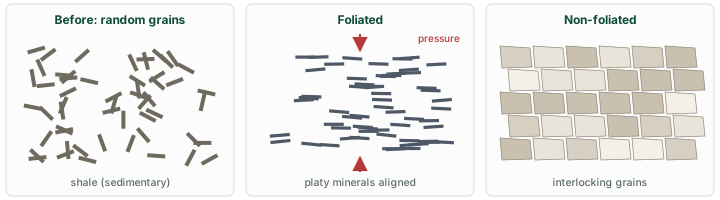
During metamorphism the grains or minerals of some rocks become arranged in layers or lines. NCERT calls this foliation or lineation. Where minerals of different groups form alternating thin to thick layers in light and dark shades, the structure is banding, and such rocks are banded rocks (NCERT). NPS explains why it happens: heat and pressure make platy or elongated minerals line up (NPS). Metamorphic rocks therefore fall into two groups: foliated (slate, schist, gneiss) and non-foliated (marble, quartzite, hornfels).
Don't confuse: An NCERT list to read carefully
NCERT's 2020 list of metamorphic examples reads "Gneissoid, granite, syenite, slate, schist, marble, quartzite". Granite and syenite are igneous rocks (NPS lists both among intrusive rocks). Granite that has been changed into gneiss is metamorphic; granite itself is not.
Parent rocks
"Types of metamorphic rocks depend upon original rocks that were subjected to metamorphism" (NCERT). The original rock is the parent rock (NPS). Four parent-to-product pairs come up again and again:
Parent rocks and their metamorphic products
| Parent rock (family) | Metamorphic rock | Texture | What it is like |
|---|---|---|---|
| Shale (sedimentary) | Slate | Foliated | Fine-grained; splits easily into slabs and thin plates |
| Limestone (sedimentary) | Marble | Non-foliated | NPS example of a non-foliated rock |
| Quartz sandstone (sedimentary) | Quartzite | Non-foliated | Medium-grained, mostly quartz |
| Granite (igneous) | Gneiss | Foliated (banded) | Alternating bands of dark and light minerals |
Source: pairs from NPS Wind Cave: Learning about rocks ("Limestone becomes marble, shale becomes slate, and granite becomes gneiss") and NPS glossary: quartzite ("Metamorphosed quartz sandstone"). Textures: NPS: metamorphic rocks; NPS glossary: slate, gneiss.
Gneiss does not always come from granite: NPS names varieties by composition, such as "granite gneiss", and gneiss can also form from sedimentary rocks. The pairs are the usual textbook cases, not the only routes.
The rock cycle
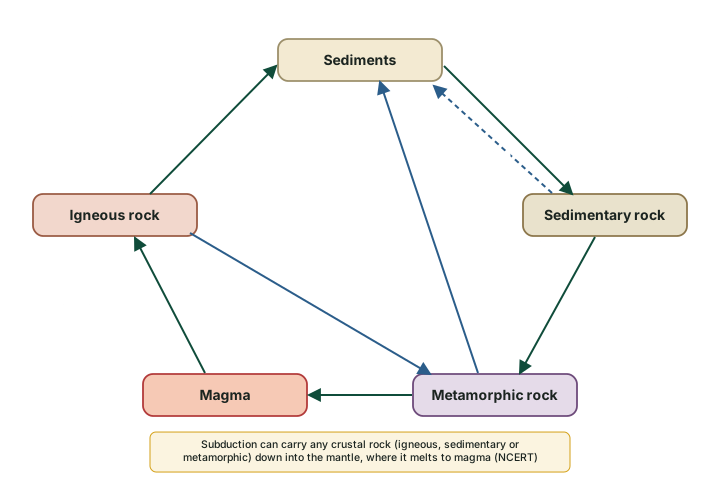
"Rocks do not remain in their original form for long but may undergo transformation" (NCERT). The rock cycle is the continuous process by which old rocks are turned into new ones. NCERT traces it in four moves:
- Igneous rocks are the primary rocks; sedimentary and metamorphic rocks form from them.
- Igneous rocks can be changed into metamorphic rocks.
- Fragments of igneous and metamorphic rocks form sedimentary rocks, and sedimentary rocks can themselves break into fragments that make new sedimentary rock.
- Crustal rocks of all three families may be carried down into the mantle by subduction, where plates converge, and melt into magma, the source of igneous rock.
Key idea
The rock cycle links this part to the rest of these notes. The arrow from rock to sediment is weathering and erosion (weathering and mass movement, erosion and deposition); the arrows from sediment to rock are deposition by rivers, groundwater, glaciers, waves and wind. Landforms are what the cycle looks like at the surface.
Rocks in India's landscape
NCERT's India volume gives the rock families a map. The Peninsula "is formed essentially by a great complex of very ancient gneisses and granites", and has stood as a rigid block since the Cambrian period. The Central Highlands have undergone metamorphism in their geological history, shown by "metamorphic rocks such as marble, slate, gneiss". On the Peninsular plateau NCERT lists tors, block mountains, rift valleys and "wall-like quartzite dykes" among the landforms (NCERT, India: Physical Environment, Class XI (reprint 2026-27), ch 2). The part on weathering explains how tors form.
Summary
- About 98 per cent of the crust is eight elements; they combine into minerals, and minerals into rocks.
- NCERT defines a mineral as organic and inorganic; the geological definition is inorganic and crystalline. Feldspar and quartz are the most common rock minerals.
- Minerals are identified by ten physical characteristics; hardness uses the Mohs scale, talc 1 to diamond 10.
- Igneous rocks are primary rocks. Slow cooling at depth gives coarse intrusive (plutonic) rock; fast cooling at the surface gives fine or glassy extrusive (volcanic) rock. Silica content divides them into mafic, intermediate and silicic.
- Sedimentary rocks form by lithification of deposited fragments; they are layered and fall into mechanical, organic and chemical groups.
- Metamorphic rocks form by recrystallisation under pressure and temperature: contact (local) or regional (extensive); foliated or non-foliated; each from a parent rock.
- The rock cycle links all three through magma, weathering, deposition and metamorphism.
The three rock families compared
| Igneous | Sedimentary | Metamorphic | |
|---|---|---|---|
| Formed by | Cooling and solidification of magma or lava | Deposition and lithification of fragments or precipitates | Recrystallisation of existing rock under pressure and temperature |
| Where | In the crust (intrusive) or at the surface (extrusive) | At the surface, in layers | Below the surface, near intrusions or in deformed belts |
| Tell-tale texture | Interlocking crystals; grain size set by cooling rate; glass in obsidian | Layers (bedding); grains cemented together | Foliation or banding, or a recrystallised mosaic |
| NCERT term | Primary rocks | Mechanical, organic, chemical | Dynamic, thermal (contact, regional) |
| Examples | Granite, gabbro, pegmatite, basalt, volcanic breccia, tuff | Sandstone, shale, conglomerate, limestone, chalk, coal, halite | Slate, schist, gneiss, marble, quartzite |
Source: NCERT, Fundamentals of Physical Geography, Class XI, 2020 edition, ch 5 (dropped from the current book); NPS pages on igneous, sedimentary and metamorphic rocks.
Sources
Each table and data figure names its source beneath it. The main documents are collected here, with a date where the source carries one. Figures not listed under image credits were drawn for this page from the sources stated in their source lines.
Main sources
| Topic | Source |
|---|---|
| Textbooks | NCERT, Fundamentals of Physical Geography, Class XI, 2020 edition, ch 5 "Minerals and Rocks" (dropped from the current book); NCERT, India: Physical Environment, Class XI (reprint 2026-27), ch 2 |
| Igneous rocks | NPS: igneous rocks |
| Sedimentary rocks | NPS: sedimentary rocks |
| Metamorphic rocks and parent rocks | NPS: metamorphic rocks; NPS Wind Cave: Learning about rocks |
| Definitions of rocks and minerals | NPS: glossary of geologic terms |
| Exposure of the Yosemite granite | NPS Yosemite: Formation of Half Dome |
Image credits
| Image | Credit and licence |
|---|---|
| Half dome granodiorite (four minerals in one rock) | National Park Service, 30 August 2016. Public domain. File page |
| Devils Postpile National Monument, California (columnar basalt) | NPS staff, 18 November 2003. Public domain. File page |
| Sandstone Cross-bedding (layers that record ancient wind) | Zion National Park, 25 May 2009. Public domain. File page |
| All other figures | Drawn for this page from the sources given in their source lines. |